Chef on OnlyFans: Restaurant Risk, Industry Recognition, and Privacy Guide
Aruna Talent Team
Creator economy experts · $10M+ annually total creator revenue
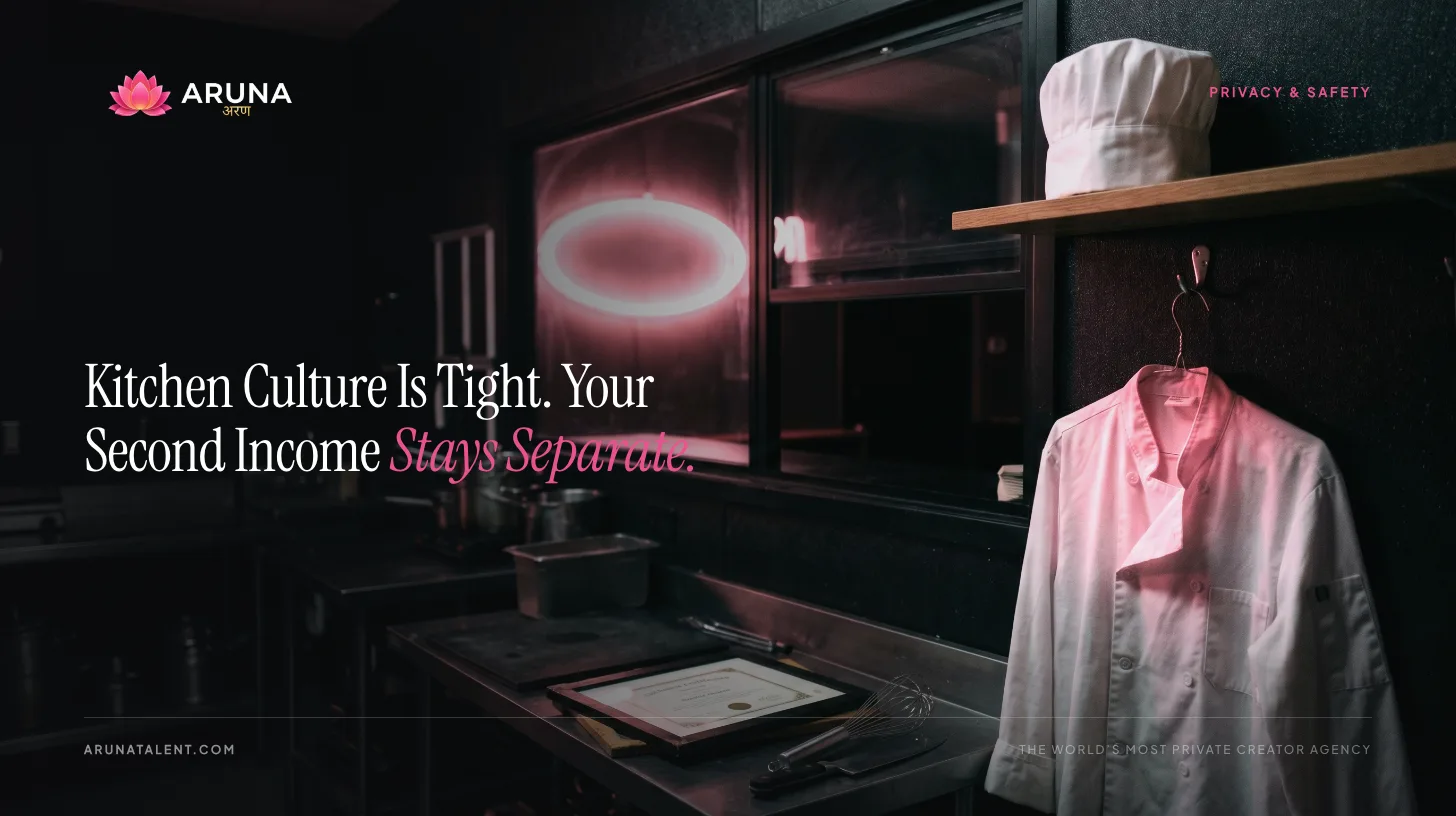
Kitchens are communities. That is what makes working in one compelling, and what makes it complicated when a chef wants to build an adult creator income on the side. The culinary industry is small, reputation-driven, and deeply interconnected. A sous chef in a mid-sized city knows the sous chef at the restaurant three blocks away. A pastry chef who competed on a regional competition three years ago still gets recognized at industry events. Food media has turned some culinary careers into genuine public identities.
This guide is for chefs at every level (line cooks, sous chefs, pastry chefs, and executive chefs) who want to create on OnlyFans without exposing their culinary career to discovery risk.
Restaurant Employer Risk
The restaurant industry is famously at-will in most employment situations. Corporate restaurant groups, independent fine dining establishments, casual chains, and hotel food and beverage operations all operate under similar norms: the people who control your schedule also control your continued employment, and they are not legally required to give you a reason for ending it.
Head chefs and restaurant owners tend to have a strong sense of their establishment’s brand and reputation. A Michelin-recognized restaurant, a high-profile tasting menu spot, or a hotel dining program tied to a luxury property brand operates under image expectations that ownership takes seriously. If they discover that a member of their kitchen team has an adult creator account, many operators will view that as incompatible with their brand, regardless of whether it has any bearing on your cooking.
Your first step before creating any account is to review your employment agreement carefully. Look for clauses covering outside employment, conduct standards, non-compete agreements, and reputational language. Many culinary employment contracts include broad language about representing the establishment appropriately. That language can be interpreted expansively. If your contract is ambiguous, consult an employment attorney in your state before proceeding.
Corporate and chain restaurant groups often have more formalized HR policies, which can cut both ways. On one hand, there may be a formal process before termination. On the other, HR departments at large groups may be more likely to act on policy violations consistently.
Kitchen Environments as Visual Identifiers
The kitchen is one of the most recognizable professional environments in existence. A chef coat, even without an embroidered restaurant name, reads immediately as culinary-professional. Specific equipment, such as a particular brand of range, a distinctive hood setup, custom tile work, or a prep area with a recognizable layout, can identify a kitchen to someone who has worked in or visited it.
Beyond the environment itself, your hands tell a story. Culinary professionals often have distinctive knife calluses, burn scars, and hand strength patterns. These are not disqualifying, but they are details that contribute to recognition risk when combined with other identifying elements.
The practical rule is simple: build your creator content entirely outside of kitchen environments. Shoot in your home. Develop a lifestyle aesthetic. Create themed or character-driven content. Whatever your creative direction, ensure that no element of your creator content places you in a professional kitchen, in chef’s whites, or in any food-preparation context that signals your profession.
The Culinary Media Crossover
Food media has elevated cooking from a trade to a cultural identity. Chef’s Table, Top Chef, and the proliferation of culinary Instagram have created a landscape where talented chefs can become recognizable public figures. If you have appeared in any food media (a local publication profile, a regional competition, a cameo in a food documentary, a feature in a restaurant’s marketing), your face and name have a media footprint that is searchable.
That footprint creates a crossover risk that ordinary employees in most industries do not face. Someone who sees your creator content and suspects your identity can search your name in the context of culinary media and potentially confirm the connection through published photos, interviews, or video appearances.
If you have any culinary media presence, audit it before creating a creator account. Understand what images of you are publicly available, what details those images reveal (tattoos, distinctive features, body proportions), and how thorough a separation you need to build to prevent a determined person from connecting the accounts.
Fine Dining vs. Casual Kitchen Risk
The risk profile differs substantially depending on where you work.
Fine dining kitchens carry the highest discovery risk for several reasons. The teams are smaller, so every person knows every other person well. The industry connections are denser, because fine dining chefs tend to be plugged into a specific professional network of other fine dining chefs, sommeliers, front-of-house managers, and food journalists. The establishments themselves are more brand-conscious and more likely to act on reputational concerns. And the career stakes are higher: a position in a respected fine dining kitchen represents years of professional development and is not easily replaced.
Casual and chain restaurant environments carry lower reputational stakes but higher volume of coworkers and industry-adjacent contacts. The trade-off is that casual kitchens typically have less reputational leverage over individual employees. Being discovered in a chain restaurant environment is less likely to result in targeted professional consequences beyond that specific job.
The mitigation strategies are the same regardless of kitchen type. The intensity with which you apply them should scale with the profile of where you work.
Culinary School and the Alumni Network
Culinary school graduates enter the industry with a built-in network: their cohort, their instructors, their externship contacts, and the broader alumni community of their institution. Well-known culinary schools (CIA, Johnson and Wales, Le Cordon Bleu campuses, prominent regional programs) have large, active alumni networks that stay connected through social media and industry events.
If you attended a culinary program in the last decade, people from that community know your face. They may follow you on social media. They work in the same city. They attend the same industry events. This community recognition risk is real and worth taking seriously.
Keep your creator persona clean of any culinary school references. Do not reference your school, the city where you attended, specific dishes or techniques associated with your training, or any detail that a school connection would recognize as specific to your educational experience.
The Tight-Knit City Culinary Scene
Major culinary markets (New York, Chicago, San Francisco, Los Angeles, New Orleans) have large industries but surprisingly small fine dining communities at the top. Chefs, sous chefs, front-of-house directors, and food journalists in these markets know each other, eat at each other’s restaurants, and follow each other on social media. Industry social networks in culinary are dense.
Smaller cities have even tighter scenes. A city of 300,000 people might have twenty restaurants doing serious culinary work. The chefs, sous chefs, and key staff at those restaurants form a community where everyone knows everyone. Discovery risk in that context is not just about your employer. It is about your entire professional network in the market where you work.
Geographic discipline in your creator content is essential. Avoid any regional references: city names, neighborhood names, local landmarks, seasonal ingredient references specific to your region, or anything that would allow a follower to place you in a specific market.
James Beard, Michelin, and Award Complications
Culinary awards come with public profiles. James Beard nominees and award recipients receive significant media coverage. Michelin-starred chefs are named publicly. If you are at a career level where awards are part of your professional identity, your public profile is substantially higher than the average culinary professional.
At this level, the separation between your creator identity and your professional identity needs to be absolute. A more sophisticated privacy approach, potentially including a legal entity that holds your creator business, a separate address for any creator-related correspondence, and careful management of any financial records that could establish a connection, is worth considering. Consult both an attorney and a CPA who have experience working with adult content creators.
Union Kitchen Environments
Hotel food and beverage operations, large casino kitchens (particularly in Las Vegas), institutional culinary programs, and some major urban restaurants operate under union contracts, typically UNITE HERE for kitchen workers in F&B settings.
Union membership provides procedural protections that at-will employment does not. You typically cannot be terminated without cause and a formal grievance process. However, union contracts are not uniform, and many contain conduct clauses that employers can point to. Your specific protections depend entirely on what your contract says.
If you work in a union kitchen, your union representative can tell you exactly what off-duty conduct protections your contract provides. This is worth knowing before you create any account. If your contract has genuine protections for off-duty legal activity, that changes your risk calculus meaningfully.
The Income Reality
Understanding the income math is important for making a rational decision.
Line cooks in the United States earn an average of $30,000 to $40,000 annually. Sous chefs typically earn $45,000 to $60,000. Executive chefs at independent restaurants range from $70,000 to $100,000, with corporate executive chefs sometimes earning above that range. These figures vary significantly by market. A line cook in New York or San Francisco earns more than the national average, but their cost of living is also substantially higher.
Creator income on OnlyFans is variable, but many creators in the $1,000 to $3,000 monthly range find it meaningfully supplements a culinary salary. For a line cook earning $35,000 annually, $1,500 per month in creator income represents a 51% increase in take-home pay. That math is compelling.
The risk-benefit calculation is personal. For a line cook at a casual restaurant with limited industry media exposure, the risk profile is manageable with proper precautions. For an executive chef at a Michelin-recognized establishment pursuing a media career, the potential downside of discovery is substantially higher. Know where you sit on that spectrum before deciding.
Building Faceless Content That Works
The most practical approach for culinary professionals is a creator brand that does not depend on your face, your kitchen, or your culinary identity at all.
Faceless content formats that work well for culinary professionals:
Sensory and aesthetic content. Focus on texture, light, movement, and atmosphere. Build a visual aesthetic that is distinct from your culinary brand.
Character or persona-driven content. A defined persona with a consistent visual style, costumes, or themed environments creates distance between the creator and the person behind the account.
Lifestyle content. Your life outside the kitchen (travel, fashion, fitness, interests) can form the basis of a creator identity that has no connection to your professional world.
Close-focus formats. Content that focuses on specific body areas rather than full-face or full-environment shots limits the identifying information in any given piece of content.
Whatever format you choose, the discipline is in the details. A kitchen timer sound, a chef’s knife visible in the background, or a stray reference to service hours can establish a culinary connection that otherwise would not exist. Review your content with fresh eyes before posting, not as someone who wants to share it, but as someone trying to identify the person behind it.
Aruna Talent manages culinary professionals who are building creator income alongside serious kitchen careers. Our approach is built around clean identity separation and sustainable income growth that does not put your culinary career at risk. If you are a chef who wants to understand your options, reach out. We are happy to talk through your specific situation without any obligation.
Ready to take your content career seriously?
Apply in a few minutes. No upfront cost. No obligation. Not ready? The free Creator Kit gets you started on your own terms.
60+ creators · $10M+ annually total revenue
You Already Know What's Possible. Now Find Out If It's Possible for You.
$20K+ your first week, that's our target, backed by 60+ launches. No followers needed. Your real name, family and location stay private, and a dedicated team drawn from a company of 100+ runs your growth. The only question is whether you apply.
See If You Qualify →No upfront cost · No obligation
How Aruna Can Help