College Student on OnlyFans: Scholarship Risk, Campus Policies, and Staying Anonymous
Aruna Talent Team
Creator economy experts · $10M+ annually total creator revenue
Last updated: May 28, 2026
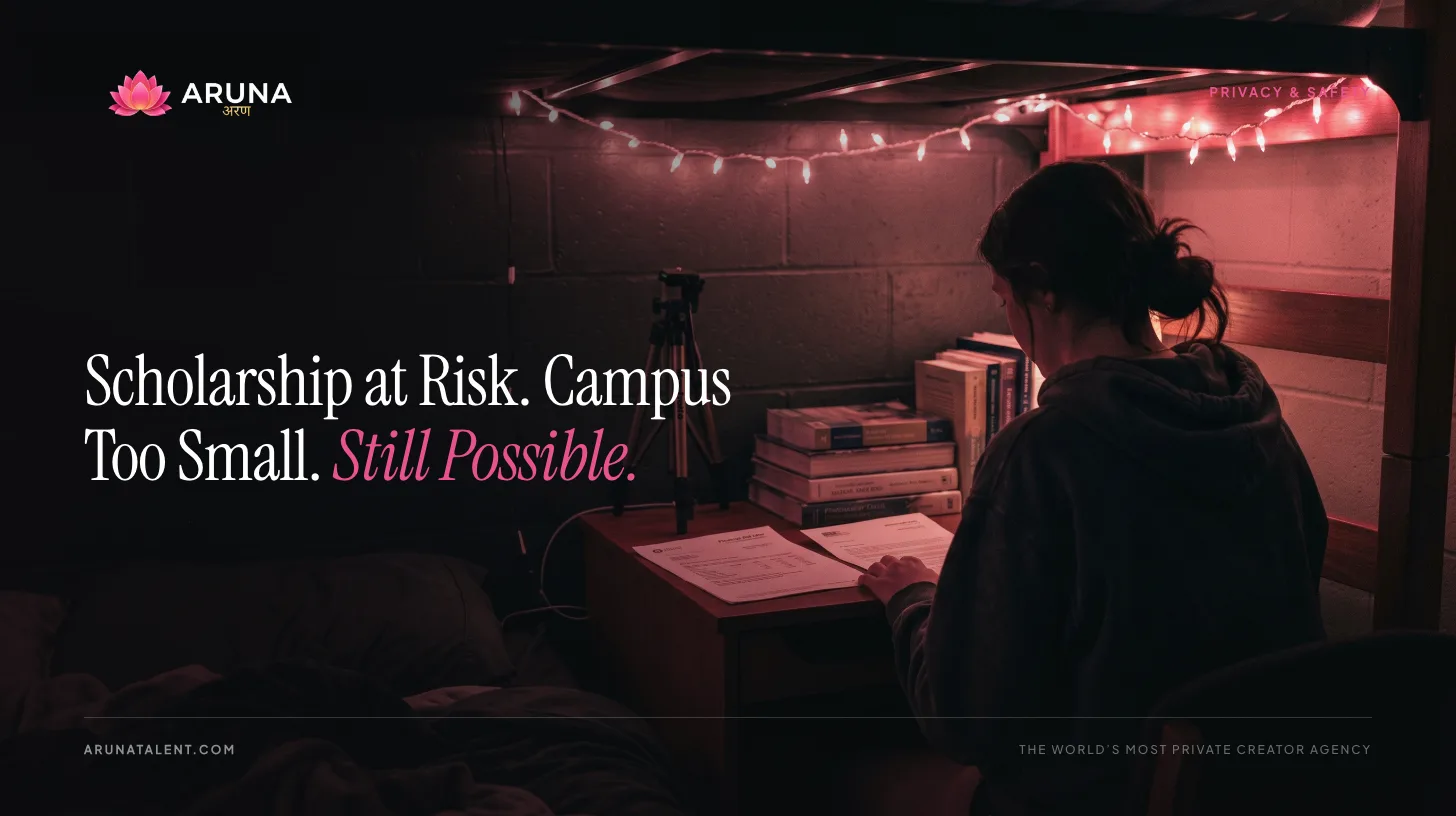
You’re here because you’re a college student thinking seriously about OnlyFans, and you want real information, not a moral lecture or a hype piece.
The risks for students are real and specific. Scholarship structures, campus conduct codes, athletic eligibility, Greek life bylaws, campus housing implications, parent discovery, and post-graduation employer searches all create a risk profile that is meaningfully different from working adults. None of those risks are necessarily disqualifying, but all of them deserve honest analysis before you make a decision.
This guide covers every one of them. Read it before you create an account.
Scholarship Risk: What Type You Have Determines What You’re Exposed To
Not all scholarships carry equal risk. The type of scholarship determines who controls it, what conditions govern it, and what enforcement looks like.
Academic Merit Scholarships
Merit scholarships issued by your university are the most exposed category. They sit within the university’s administrative control, funded by institutional resources, and governed by the same student conduct infrastructure that governs disciplinary proceedings.
Most merit scholarship agreements include conduct clauses: language that grants the institution discretion to suspend or revoke aid if the recipient is found in violation of the student code of conduct. The threshold varies by school. Some codes require a formal finding through the conduct process; others give administrators broader discretionary authority.
The key phrase to look for in your own scholarship agreement: “continued enrollment in good standing” or “compliance with university policies.” If those conditions appear, a conduct finding, even a minor one, can trigger a financial aid review.
Private and Foundation Scholarships
Scholarships issued by private foundations, corporations, or nonprofits are governed by their own documentation, not by your university’s conduct code. Most private scholarship agreements focus on academic performance criteria: maintain a 3.0 GPA, remain enrolled full-time, submit annual verification. Legal off-campus activities rarely appear in these agreements.
If your primary scholarships are private, your exposure through the scholarship channel is lower. Read the actual terms of your agreement to confirm. Don’t assume based on the category.
Federal Aid
Pell Grants and other federal need-based aid are determined by FAFSA criteria. Federal aid eligibility is governed by enrollment status, financial need, and satisfactory academic progress, not by conduct or off-campus activities. A conduct finding at your university does not automatically trigger federal aid loss.
However, if your OnlyFans income is significant, it will appear on your tax return, which flows into your FAFSA the following year. Meaningful earned income reduces your expected financial contribution calculation and can reduce need-based eligibility in the next award year. The threshold where this starts to matter varies by your existing financial profile.
Student Conduct Codes: What the Policies Actually Say
Here is the most important clarification in this entire guide: Title IX does not apply here.
Title IX prohibits sex-based discrimination in educational programs and activities that receive federal funding. It governs how your university must respond to sexual harassment, assault, and discrimination. It has no jurisdiction over a student’s legal off-campus economic activities. Any claim that OnlyFans creates a Title IX issue for you as the creator is incorrect.
The relevant policy is your student conduct code, sometimes called the student handbook or community standards document. That document governs student behavior and determines what the university can and cannot do when a student’s conduct is brought to their attention.
What Conduct Codes Actually Contain
No major university’s conduct code names OnlyFans. What they contain is discretionary language:
- “Conduct unbecoming a student of this institution”
- “Actions that bring disrepute to the university”
- “Violation of community standards”
- “Moral turpitude”
- “Behavior incompatible with membership in this academic community”
These clauses exist because conduct code drafters cannot anticipate every situation. They are broad by design, and they are interpreted by conduct officers who exercise discretion.
The three conditions required for any of this language to apply to you: someone must discover your account, connect it to your real identity, and file a formal complaint. Conduct proceedings do not initiate themselves. They require a complainant.
Read your actual student handbook. Find the specific language. Know which clauses could theoretically apply and which cannot. Then build the anonymity infrastructure that makes the complaint-and-connection chain practically impossible.
Private vs. Public Universities
Private universities, particularly faith-affiliated institutions, often have broader and more aggressively enforced conduct codes. Morality clauses are more common, more explicitly written, and more actively monitored in some private institutional contexts.
Public universities are constrained by constitutional considerations. A public university attempting to discipline a student for legal off-campus activities faces First Amendment exposure. That does not mean public universities never try, but the legal landscape is more favorable for students at public institutions.
Athletic Scholarships and NCAA Eligibility
Student athletes face a distinct and more serious risk profile than non-athletes. This deserves its own analysis.
Athletic scholarships are employment-adjacent agreements. They come with a roster of conditions that go well beyond the academic conduct standards that govern merit scholarships. Morality clauses in athletic scholarships are typically explicit, actively monitored, and enforced at the coaching and athletic department level, not just through the formal conduct process.
NCAA Eligibility
The NCAA permits Name, Image, and Likeness (NIL) agreements, but with clear boundaries. Adult content creation is explicitly excluded from permissible NIL activity under most institutional NIL policies and is incompatible with the general spirit of permissible endorsement activity under NCAA frameworks.
The risk for a student athlete is not just scholarship revocation. It is loss of athletic eligibility, which means loss of your ability to compete, which affects your team, your athletic department, your scholarship, and potentially your professional prospects if you play a sport with a professional trajectory.
Athletic departments have compliance offices specifically monitoring for eligibility violations. That monitoring is ongoing.
If you are a scholarship athlete and you are considering content creation, consult a sports attorney before taking any action. This is the one category in this guide where the risk profile is severe enough that independent legal counsel is not optional.
Greek Life Discovery Risk
Greek organizations operate under bylaws that are separate from both university conduct codes and athletic department policies. Your chapter’s rules are your chapter’s rules. They exist in a separate document with separate enforcement mechanisms.
Most sorority and fraternity bylaws do not mention OnlyFans or any specific platform. They use broad organizational conduct language: requirements to uphold the values of the organization, not to bring negative attention to the chapter, to conduct yourself in a manner consistent with membership standards.
Whether that language is applied to content creation depends on three variables: your chapter’s leadership, your national organization’s stance, and whether anyone discovers your account and chooses to escalate it.
The discovery-to-enforcement chain still requires someone connecting your content to your real identity. Creators who maintain complete identity separation (stage name, separate accounts, no identifying details in content, geographic blocking covering their campus area) have significantly reduced this risk in practice.
For a complete analysis of Greek life-specific considerations, see our sorority OnlyFans guide.
Campus Housing Implications
Creating content in university housing introduces a specific wrinkle that off-campus housing does not.
Your dorm room is university property. Equipment, furniture, signage, and architectural features within it are institutionally identifiable. Content created in a dorm room with visible university-branded or campus-identifiable elements creates a connection between your creator identity and university property.
That connection is not automatically a conduct violation. But it provides a factual nexus that a conduct officer or housing administrator could use if they were already investigating a complaint.
The practical rule: do not create content in spaces where institutional identifiers are visible. Neutral backgrounds, off-campus locations, or settings where nothing connects the space to your university are all preferable. This is a straightforward operational choice that eliminates an unnecessary risk vector.
Campus networks present a separate consideration. University WiFi is monitored. Do not access your creator accounts, upload content, or conduct any creator business on a campus network. Use personal mobile data or a home connection.
Financial Aid and Student Loans
The FAFSA calculates your Expected Family Contribution using prior-year income from your tax return. OnlyFans income is self-employment income. It is fully taxable, fully reportable, and it will appear on your return.
If your creator income is meaningful, it flows into the following year’s FAFSA calculation and can reduce need-based aid eligibility. This is a timing issue: income earned during your sophomore year affects your junior year aid package.
Federal student loans (subsidized and unsubsidized Stafford loans) are determined by enrollment status and aggregate limits, not by your income. Your ability to borrow federal loans is not affected by how you earn money.
Private scholarships are governed by their own terms. Most have no income monitoring provision and no mechanism to detect your earnings. Conduct-based scholarships are the exception, not the rule.
RA and Campus Staff Discovery
Resident Advisors and campus housing staff are student employees. They are not mandatory reporters for legal off-campus activities. If an RA becomes aware that you have a creator account, they have no automatic institutional obligation to report it.
However, RAs are embedded in your residential community and operate under the same housing policies as other students. If they observe you creating content in shared spaces, or if content involving shared or institutional spaces circulates and comes to their attention, the situation changes.
The practical guidance: keep your creator activities entirely private. Do not discuss your work in your residential community. Do not use shared spaces for content creation. Keep all equipment stored in a way that does not invite curiosity or conversation.
Parent Discovery: The Specific Risk for Traditional-Age Students
For students aged 18–22, parent discovery is one of the most emotionally weighted risk scenarios, and one of the most practically manageable with the right infrastructure in place.
The most common discovery vectors for parents:
Hometown social circles. If someone from your home community or high school finds your account and recognizes you, the information can travel back to your family through social networks you no longer control.
Geographic proximity. If your parents live in the same region as your campus and you have not geo-blocked that area, they or their social networks can organically encounter your profile.
Tax documents. Your 1099-NEC from OnlyFans will be mailed to your address under your legal name. If you return home during breaks and share an address with your family, those documents arrive in a household where others may see them.
Reverse image search. If your face appears in any creator content and also appears in personal social media, anyone can connect them. This is a technically simple search that requires no special access.
The mitigations are operational. Geo-block your home city and home state before anything goes live. This is done before you publish your first piece of content, not after. Maintain complete name and face separation from your personal identity. Use a separate address (PO box or trusted contact) for financial correspondence if you share a household during breaks.
Campus Community Recognition Density
College campuses are high-density social environments. You interact with the same few thousand people repeatedly across academic, residential, and social contexts. This creates a recognition risk that does not exist in the same way for creators living in large metropolitan areas.
A creator in New York City with one million potential nearby viewers has effectively zero chance of organic campus-style recognition. A creator on a 4,000-person campus where everyone has seen your face has a fundamentally different exposure profile.
This is why geographic blocking covering your campus and surrounding area is not optional for college students. It is the single most important technical protection available. At Aruna Talent, geo-blocking is applied on request where it makes sense for you, and for a student that covers the campus city, home city, and home state. This eliminates the most likely discovery vector: a classmate, professor, or community member stumbling onto your profile during normal platform browsing.
The campus density problem also means that faceless or face-obscured content strategies carry more value for college students than for creators in other contexts. Building a subscriber base with masked, anonymous, or face-free content means that even if your account is discovered, there is no verified connection to your identity.
Students Who Appear in University Media
If your face, name, or voice have been published in university-controlled media (department websites, student news outlets, athletic rosters, club Instagram accounts, university publications, or promotional materials), that content is indexed by search engines and findable through name search and reverse image search.
This is a specific and underestimated risk. A university news article with your photo, a department website listing you as a student researcher, an athletic roster with your headshot: all of these create a searchable public record that can be used to connect a pseudonymous creator to a real identity.
The audit before launch: Google your full legal name. Run your photos through reverse image search tools. Review what is publicly indexed about you and where. Assess whether your face is distinct and searchable enough to create identification risk even with a stage name.
The mitigation: faceless content strategy until you have assessed and accepted the actual risk. Aruna Talent runs this digital footprint audit for every creator before account setup. It is a standard onboarding step, not an afterthought.
Post-Graduation Employer Background Checks
Standard employment background checks verify criminal history, employment history, education credentials, and professional references. They do not query OnlyFans, adult content platforms, or personal social media.
Your creator account will not appear in a background check.
The real exposure is your digital footprint. Most employers now conduct informal internet searches on candidates before or after interviews. If your legal name is publicly associated with your creator profile (through a profile bio, a social media cross-post, a leaked connection), a basic Google search surfaces it.
The protection is the same at graduation as it was on day one of your creator career: your legal identity and your creator identity must be completely separated. Creators who maintained strict anonymity throughout their career have nothing to worry about from employer internet searches. The window of risk is any moment where the separation was allowed to slip: a personal account cross-posted to a promotional one, a real name used in a caption, a face visible in content that also appears in professional photos.
Anonymity Infrastructure for College Students
Every risk category in this guide has the same root mitigation: your real identity must never be linkable to your creator identity.
This is not a single step. It is infrastructure: a set of layered protections that, together, make the connection between your legal name and your creator account practically impossible to establish.
Here is what that infrastructure looks like:
Stage name. Not your middle name, not a nickname your friends use, not a variation of your real name. A completely invented identity with no connection to your real one.
Separate accounts for everything. Creator email, promotional social media, payment processing, all isolated from any account connected to your real name or personal life.
Geographic blocking before launch. Your campus city, your home city, your home state, all blocked before the first piece of content goes live. This is done before launch, not after discovery.
No identifying details in content. No university logos, no campus buildings, no Greek letters, no apparel or décor that narrows your location. No face in early content, at minimum until you have assessed and accepted the risk.
Separate devices and separate networks. Personal mobile data for all creator work. Never campus WiFi. Content storage separate from personal devices.
DMCA monitoring. Unauthorized redistribution of your content is a real threat. Monitoring services that scan hundreds of sites for your content and issue takedowns are not a luxury. They are a standard operating requirement. Aruna Talent monitors 500-plus sites continuously for every creator in the portfolio.
Aruna Talent has maintained zero identity leaks across four-plus years of managing creators. That track record reflects an infrastructure-first approach: the anonymity systems are built before anything goes live, tested against real privacy scenarios, and maintained throughout the creator’s career.
Related Guides
If specific aspects of your situation need deeper coverage:
- OnlyFans in College: The Honest Guide Students Actually Need
- Sorority Women on OnlyFans
- Athlete on OnlyFans
- How to Stay Anonymous on OnlyFans
- OnlyFans Taxes
- DMCA Takedowns and Content Protection
- Can OnlyFans Be Traced Back to You?
What Professional Management Looks Like
Consider what it means to enter this with the infrastructure already built: anonymity systems tested against real scenarios, geo-blocking applied on request where it makes sense for you, DMCA monitoring running continuously across 500-plus sites, and a strategy built on data from 60-plus creators rather than trial and error.
Aruna Talent generates eight figures a year in combined portfolio revenue. $10M-plus in annual creator earnings. A $20K-plus first-week target for qualified creators. Zero identity leaks across four-plus years. Real names, families and locations kept private for every creator in the portfolio, including college students navigating exactly the risk categories covered in this guide.
The privacy concerns you just read about are real. The opportunity is also real. Working with people who have navigated both, hundreds of times, is what separates a creator who builds a sustainable income from one who stumbles into a preventable problem.
Ready to take your content career seriously?
Apply in a few minutes. No upfront cost. No obligation. Not ready? The free Creator Kit gets you started on your own terms.
60+ creators · $10M+ annually total revenue
You Already Know What's Possible. Now Find Out If It's Possible for You.
$20K+ your first week, that's our target, backed by 60+ launches. No followers needed. Your real name, family and location stay private, and a dedicated team drawn from a company of 100+ runs your growth. The only question is whether you apply.
See If You Qualify →No upfront cost · No obligation
How Aruna Can Help