Cosmetologist on OnlyFans: License Risk, Salon Employer, and Privacy Guide
Aruna Talent Team
Creator economy experts · $10M+ annually total creator revenue
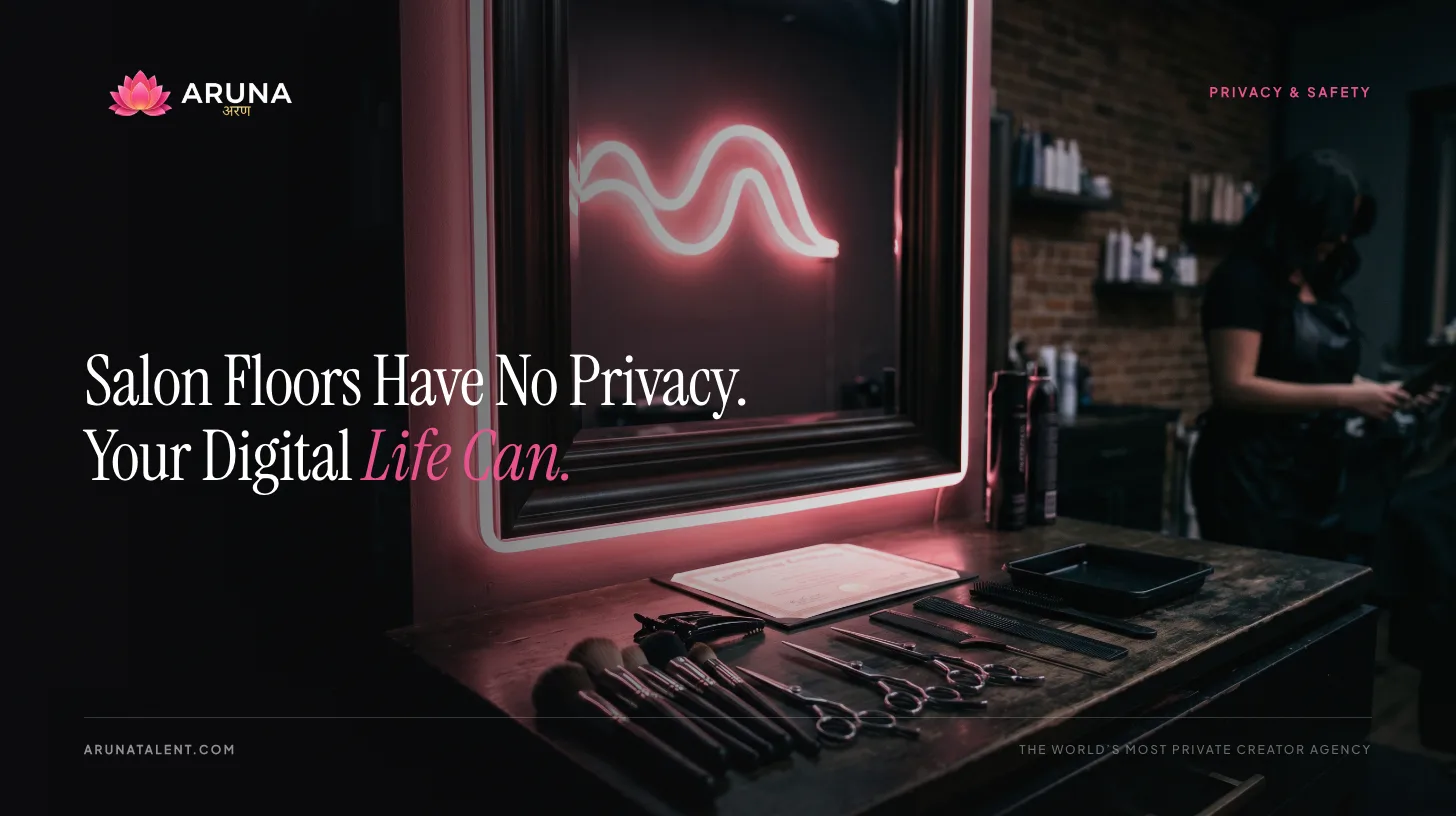
Cosmetology is one of the most relationship-intensive licensed professions. You spend hours with the same clients every few weeks, build personal connections that span years, and work in a community where everyone knows everyone. That professional intimacy is what makes the career rewarding, and what creates specific challenges for cosmetologists on OnlyFans.
The risks are real, but they’re manageable with the right framework. This guide covers the specific exposure vectors for cosmetologists and what to do about each one.
State Cosmetology Board Licensing Risk
Cosmetology is licensed at the state level, with boards that regulate training standards, sanitation practices, and professional conduct within the scope of practice. No state cosmetology board has an explicit rule against adult content creation. The boards exist to protect public health and safety in the delivery of cosmetology services, not to regulate what licensees do in their personal time.
That said, several states include general character or professional reputation language in their licensing standards, and a complaint filed with the board by a motivated third party can trigger an investigation. The investigation itself, even one that ultimately goes nowhere, creates stress and documentation. More importantly, if an employer or client files the complaint, the investigation can affect your ability to work at certain salons while it’s open.
The licensing risk chain almost always starts with employer or client discovery, not with board monitoring. The board does not have resources or motivation to proactively search for licensees on adult platforms. What the board does is respond to complaints. Preventing discovery prevents the complaint.
State-specific considerations: States with broader professional conduct language in their cosmetology statutes (certain Southern states and some Midwestern states) have historically had board members more inclined to pursue complaints on character grounds. If you’re licensed in a state with active board enforcement culture, understand your specific state’s standards before starting.
Salon Employer Discovery
For employed cosmetologists, the salon employer relationship creates the most immediate practical risk. Salon owners control your working environment, your client book access, your scheduling, and your professional reputation within a local market. Discovery does not require formal board action to create significant professional harm.
A salon owner who discovers your account can terminate employment without cause in at-will employment states. They can choose not to renew a staffing arrangement. They can be subtle (reduced scheduling, fewer referrals, a cooler professional environment) in ways that make the working relationship untenable without creating a legal termination claim.
The more significant long-term risk is reputational. Local beauty markets are genuinely small. Salon owners know other salon owners. A reputation issue at one salon can follow you to other employment prospects in the same market. This isn’t hypothetical. It’s how the local beauty industry operates.
Employed stylists should pay particular attention to any outside activities or secondary income clauses in their employment agreements. These are less common in salon employment than in professional services firms, but some larger salon chains and franchises include them. Read your agreement and understand what it covers.
Booth Renter Risk Profile
Booth renters occupy a different legal position than employees. You are a self-employed business owner renting space in a salon: you set your own hours, manage your own clientele, and operate your own book independently from the salon owner’s direction. This autonomy matters.
The salon owner cannot terminate your lease mid-term for reasons not specified in the rental agreement without proper legal process. You have more legal protection than an at-will employee.
But the protection has real limits. Most booth rental agreements are short-term: month-to-month or one-year terms. A salon owner who becomes uncomfortable with your creator work can simply decline to renew your lease at the next term. You lose your location, your client walk-in access, and potentially significant momentum in your client retention.
Beyond the lease, booth renters still depend on the salon’s professional environment, its reputation, its client walk-ins, and its referral network. Even with full legal independence, you are embedded in a social and professional ecosystem where discovery creates consequences.
The Beauty Social Media Problem
This is the exposure vector that catches most cosmetologist creators off guard. Cosmetologists build professional Instagram accounts as a core business practice. Your professional Instagram shows your work, which means your hands, your face, your signature style, your aesthetic preferences, and your personality.
A professional cosmetology Instagram is a personal brand portfolio by design. The goal of that portfolio is to make your face, style, and personality recognizable so that potential clients book with you. It works exactly as intended, and creates a direct bridge between your professional identity and your creator identity if any visual element overlaps.
Your creator account must be visually and stylistically distinct from your professional portfolio. That means:
- No face, no identifiable hair or nail style that matches your professional portfolio
- Different makeup aesthetic or style that doesn’t read as “your look”
- No products, color brands, or professional equipment visible in the background
- No references to beauty work, salon life, or beauty industry content in creator content or messaging
If a client, colleague, or competitor who follows your professional Instagram can look at your creator content and recognize a visual connection (your hands, your style, your ring, your nail art), the separation has failed.
Client Recognition Risk
Cosmetology clients sit in your chair for three to four hours during color and highlight appointments. These are long, conversational appointments that repeat every six to eight weeks, often for years. By the end of a year, a color client knows your face better than most of your personal friends do. They know your voice, your laugh, your opinions, your family situation, your stories.
This level of personal familiarity creates recognition risk that goes beyond facial recognition. A client who finds your creator account may recognize your voice in a video, your laugh, your mannerisms, your hands. Geographic content blocking of your work area significantly reduces the probability of a local client finding the account. It does not eliminate the risk for clients who find content through search, recommendation, or external links.
Nail technicians have an additional specific consideration: hands are the portfolio. If your hands are recognizable from professional nail content on your Instagram (the shape, the rings you wear, your nail style) and hands appear in creator content, the recognition bridge is direct. Remove rings during shoots, avoid any nail style that appears in professional portfolio content, and never photograph hands in a way that could cross-reference with professional nail portfolio images.
Booth Renter vs. Employee: Practical Comparison
| Factor | Employee | Booth Renter |
|---|---|---|
| Termination risk | High (at-will, immediate) | Lower (lease term protects mid-contract) |
| Non-renewal risk | N/A | Real (same as employee risk at term end) |
| Client book portability | Employer may control | You own your client book |
| Salon reputation dependency | High | Moderate (partially buffered by independent business) |
| Employment agreement restrictions | Common | Lease agreement rarely covers personal conduct |
| Local market reputation risk | High | High (same community dynamics) |
The Beauty Community Small-World Dynamic
Local beauty markets are tight-knit in a way that most industries are not. Salon owners know each other. Distributors who service multiple salons know the stylists. Platform reps who visit salons for product education know the community. Education events, trade shows, and continuing education requirements bring stylists from across a market together regularly.
This small-world dynamic means that information about a stylist travels faster and more widely than in most professional communities. A discovery that starts with one salon owner can reach other salon owners, distributors, and educators within the local market faster than it would in a larger, more siloed industry.
Geographic blocking covers the most critical exposure point, but the social network dynamics of a tight-knit professional community are worth taking seriously. The more personally identifiable your creator content, the faster information about it moves if discovered.
How to Avoid Beauty Environment Identifiers
Specific items to check before any shoot:
Products visible in frame: Remove any professional product lines from visible surfaces: color lines, styling products, treatment lines. These are brand identifiers even when small and out of focus.
Equipment in background: Styling trolleys, color bowls, foil packets, and sectioning clips are visually distinctive. Nothing that reads as salon equipment should appear in content.
Lighting setup: Salon lighting rigs are distinctive. Shoot in different lighting environments from your professional working environment.
Your hands: Ring combination, nail style, hand shape, and nail length are recognizable. Use consistent rings-off policy during all shoots. Maintain a nail style that doesn’t appear in your professional portfolio.
Salon-specific apparel: Smocks, aprons, and professional attire distinctive to salon work. Never wear anything that could visually associate with cosmetology.
Income Context
Cosmetologists earn an average of $35,000 to $55,000 annually, with significant variation by market, clientele, and specialization. Color specialists in major markets with established books can exceed this range. Nail technicians and estheticians in competitive markets often earn toward the lower end of the national average.
OnlyFans creator income at even modest production levels ($2,000 to $5,000 per month for consistent mid-tier creators) represents a 50% to 100% income supplement against cosmetology base earnings. The financial case is significant. For early-career stylists building a client book while earning below average, the gap is even larger.
The risk management effort required to protect your cosmetology career is real. It is also proportionate to the income opportunity. Managing the specific exposure vectors for beauty professionals (salon environment identifiers, professional social media crossover, client recognition, small-world community dynamics) produces a framework where both income streams operate without threatening each other.
Complete Identity Separation Framework
For cosmetologists, the foundational requirements:
Pseudonym: A stage name with no connection to your real name, your professional market, your salon name, or any social handle associated with your cosmetology career.
Separate email and accounts: A dedicated email for OnlyFans that has never touched your professional email server, your professional social accounts, or your personal devices used for work.
Device separation: Content creation and account management happen on a device that never connects to salon Wi-Fi and never runs your professional accounts.
Geographic blocking: Block your work city, surrounding cities in your professional market, and any cities where you attend industry education events.
Visual separation: No face in content, or a distinct visual presentation with no overlap with professional portfolio imagery. No hands in content unless rings are removed and nail style is different from professional portfolio.
Social account separation: Your creator account has no connection (no cross-links, no shared followers, no shared content) with your professional cosmetology social media.
These requirements are more demanding for beauty professionals than for most occupations because the visual, social, and community exposure vectors are more numerous. The framework addresses each one specifically.
Building this alone caps how far it goes. Aruna Talent runs content strategy, daily fan messaging, growth, and privacy protection for 60+ creators. See if you qualify →. It takes about a minute, and a straight no is a useful answer too.
Ready to take your content career seriously?
Apply in a few minutes. No upfront cost. No obligation. Not ready? The free Creator Kit gets you started on your own terms.
60+ creators · $10M+ annually total revenue
You Already Know What's Possible. Now Find Out If It's Possible for You.
$20K+ your first week, that's our target, backed by 60+ launches. No followers needed. Your real name, family and location stay private, and a dedicated team drawn from a company of 100+ runs your growth. The only question is whether you apply.
See If You Qualify →No upfront cost · No obligation
How Aruna Can Help