EMT on OnlyFans: License Risk & Anonymity
Aruna Talent Team
Creator economy experts · $10M+ annually total creator revenue
Last updated: May 28, 2026
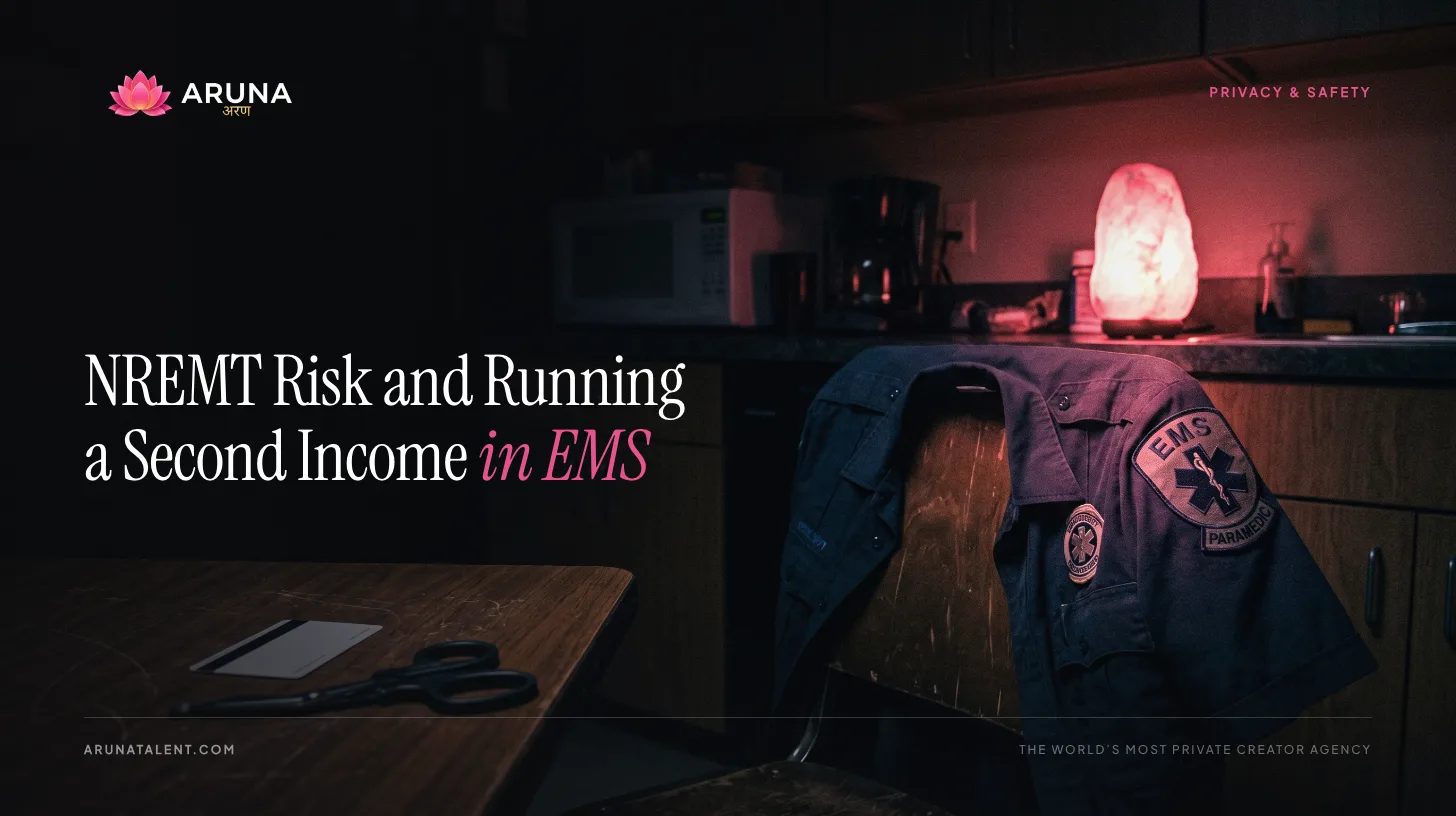
EMTs occupy a risk landscape shaped by two parallel tracks: NREMT certification that can be reviewed under character and fitness standards, and employer conduct policies that vary significantly based on whether the EMT works for a fire department, private ambulance company, or hospital system. The recognition risk is lower than for clinic-based healthcare providers, but the first responder community culture creates meaningful colleague discovery exposure.
The risks are manageable. What managing them requires is understanding which employer track applies and building identity separation accordingly.
NREMT Certification and State EMS Licensing
The National Registry of Emergency Medical Technicians (NREMT) issues national EMS certifications at the EMT-Basic, Advanced EMT, and Paramedic levels. Most states require NREMT certification for state EMS licensure, though some states maintain independent licensing systems.
NREMT’s Character and Fitness framework applies to initial certification and, under NREMT policy, can apply in renewal and disciplinary contexts. Like most professional credentialing bodies, NREMT investigates complaints. It doesn’t proactively monitor creator platforms.
The disciplinary chain requires a complaint. A complaint requires discovery. A properly anonymous account that cannot be linked to a specific NREMT-certified provider creates no certification exposure.
State EMS offices maintain separate licensing authority and can investigate complaints independently. A complaint filed with a state EMS office triggers a state-level review under the state’s EMS practice act. The outcome depends on the state’s conduct standards and the specific complaint framing.
Employer Risk by Setting
Fire department EMTs are public employees in most jurisdictions, subject to civil service frameworks, departmental conduct standards, and, frequently, union agreements. Civil service protections and union grievance procedures mean termination follows a more procedurally defined process than private employment. Discovery at a fire department typically triggers a formal HR investigation before any employment action.
Private ambulance company EMTs at AMR (American Medical Response), Rural/Metro (part of Global Medical Response), and regional private EMS operators are private employees subject to company conduct policies. These companies have HR infrastructure but exercise more discretion than civil service employers. Non-union private ambulance EMTs have the least procedural protection if discovery leads to a conduct determination.
Hospital-based EMS providers work within healthcare employment frameworks: formal HR, documented conduct policies, and legal and compliance infrastructure. Discovery at a hospital EMS system follows a healthcare employer pathway.
Volunteer EMS members don’t face employment termination risk, but volunteer organizations have membership standards and can remove members for conduct that reflects on the organization. Volunteer EMTs who also hold paid positions elsewhere carry their paid employer’s conduct risk through that separate relationship.
Recognition Risk in EMS
EMS provider recognition risk is structurally different from clinic-based healthcare. Most EMS interactions are acute and non-recurring. Patients in medical emergencies don’t typically build long-term provider recognition the way outpatient clinic patients do.
The exceptions:
- High-frequency callers in a defined service area who have repeated EMS contact do recognize individual providers
- Community outreach participants who meet providers at health fairs, school events, or community programs
- Colleagues and station staff who interact daily in the close-quarter environment of a fire or EMS station
Colleague discovery is the highest-probability recognition vector for most EMTs. The first responder community is tight-knit, and colleagues know each other’s social media presence. Geographic blocking of the service district is the primary technical protection against passive community discovery.
EMS-Specific Content Environment Risks
Uniforms and department insignia. EMS uniforms are among the most recognizable professional attire in healthcare. Department-specific colors, shoulder patches, badge configurations, and (for cross-trained fire/EMS personnel) turnout gear create immediate identification. Uniforms should never appear in content, and any department-specific items should be removed from the content environment entirely.
Vehicle and station interiors. Ambulance cab interiors, station common areas, apparatus bays, and the medical equipment visible in EMS environments (AED units, monitor-defibrillators, stretcher systems, oxygen equipment) are recognizable to patients and community members with EMS experience.
Department social media presence. EMTs who appear in department social media posts, local news coverage, or community outreach documentation have documented visual records that can be cross-referenced against creator content.
Identity Protection Framework
Pseudonym. No connection to your real name, department name, service district, or EMS certification level. Avoid references to emergency medicine, emergency services, first response, or the first responder lifestyle in your creator identity.
Content environment. No uniforms, no department insignia, no EMS equipment, no station or vehicle environments. Content created in the home or a purpose-built environment with no professional identifiers addresses the environment risk entirely.
Geographic blocking. Block your service district and surrounding community area. For fire department EMTs, block the entire fire district, not just the station neighborhood.
Device separation. A dedicated device never used for department systems, computer-aided dispatch platforms, or professional email accounts.
How Aruna Talent Supports First Responders
Aruna Talent manages creators across first responder professions (paramedics, EMTs, firefighters, and law enforcement professionals) where employer discovery and certification risk create real professional exposure.
The privacy infrastructure is built for this risk profile: fake name systems applied consistently across all communications, geographic blocking from service districts and department jurisdictions, NDA-enforced team confidentiality, and DMCA monitoring across 500+ sites. Zero identity leaks in four-plus years.
Related guides:
- Paramedic on OnlyFans: NREMT certification, state EMS licensing, and advanced life support provider identity protection
- Firefighter on OnlyFans: fire department employment, civil service frameworks, and firefighter identity protection
- Police Officer on OnlyFans: law enforcement employment, internal affairs risk, and officer identity protection
- Nurse on OnlyFans: nursing board risks and healthcare-specific identity protection
If you’re ready to explore full-service management with privacy infrastructure built for first responders, apply to work with Aruna Talent.
Ready to take your content career seriously?
Apply in a few minutes. No upfront cost. No obligation. Not ready? The free Creator Kit gets you started on your own terms.
60+ creators · $10M+ annually total revenue
You Already Know What's Possible. Now Find Out If It's Possible for You.
$20K+ your first week, that's our target, backed by 60+ launches. No followers needed. Your real name, family and location stay private, and a dedicated team drawn from a company of 100+ runs your growth. The only question is whether you apply.
See If You Qualify →No upfront cost · No obligation
How Aruna Can Help