Flight Nurse on OnlyFans: HEMS Employer Risk, Licensing, and Privacy Guide
Aruna Talent Team
Creator economy experts · $10M+ annually total creator revenue
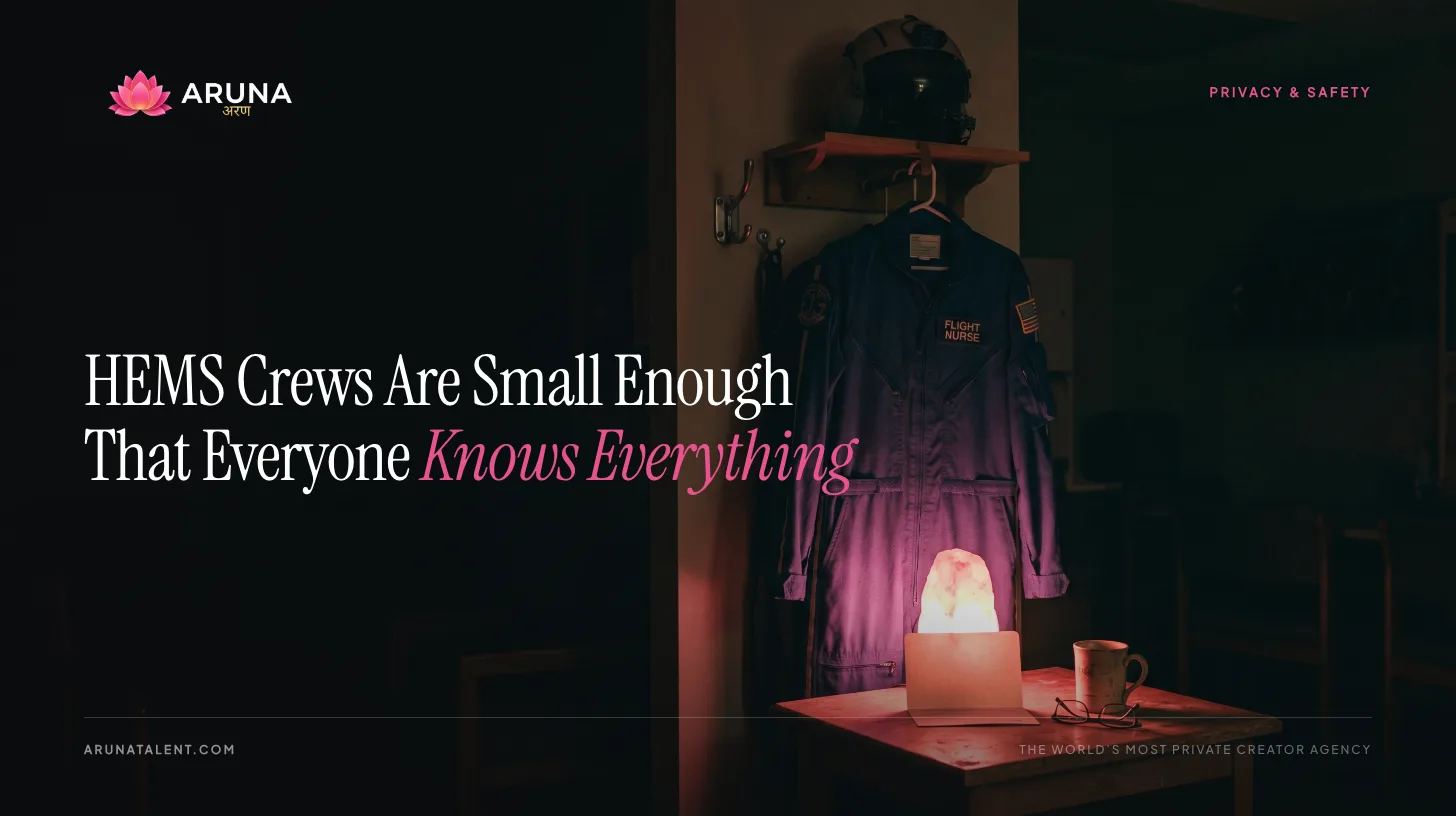
Flight nursing is one of the most demanding and specialized roles in emergency medicine. You operate in a tight crew, in a distinctive environment, under employer conduct standards that exceed most clinical settings. The professional investment to reach a flight nurse position (RN licensure, critical care experience, CFRN certification, HEMS program selection) is measured in years.
The risks of running an OnlyFans account as a flight nurse are real and specific. They are also manageable with the right framework. This guide covers each risk vector and what to do about it.
The Nursing License Foundation
Flight nurses hold state RN licenses, the same licenses as hospital floor nurses, ICU nurses, and every other registered nurse. The state nursing board does not distinguish between HEMS nurses and hospital nurses in terms of licensing jurisdiction. If a complaint is filed, it is adjudicated under the same nursing practice act that governs all RNs in that state.
No state nursing board maintains an explicit prohibition on adult content creation. Nursing boards regulate the practice of nursing (patient care standards, professional conduct in clinical settings, scope of practice violations), not lawful personal activities. But the character and fitness language in most state nursing practice acts creates a basis for a complaint to be filed, and some boards have pursued disciplinary action against nurses following third-party complaints.
The important distinction: boards do not proactively search for nurses on adult platforms. They respond to complaints. The complaint almost always originates from an employer, a colleague, or a patient, not from independent board surveillance. For flight nurses, the primary source of complaint would be HEMS employer discovery, and the small-crew dynamics of air medical programs make discovery more likely than in most healthcare environments.
Understanding this chain (discovery triggers complaint, complaint triggers investigation) clarifies the protective priority. Prevention of discovery is the primary action. Investigation response strategy is secondary.
HEMS Employer Conduct Standards
Helicopter emergency medical services programs maintain professional conduct standards that exceed typical hospital employer policies. The reasons are structural: HEMS programs operate under FAA oversight, maintain aviation safety cultures, depend on public trust in emergency response, and manage the reputational sensitivity of air medical care. These factors combine into employer expectations that are unusually explicit about professional conduct outside of work.
Large HEMS operators (Air Methods, PHI Air Medical, Global Medical Response companies, hospital-based programs) have formal conduct policies that extend beyond clinical work hours. Some programs require employees to disclose outside income-generating activities. Some programs include social media conduct clauses that address content reflecting on the program’s professional reputation.
The practical implication: review your employment agreement’s outside activities and professional conduct clauses before starting a creator account. These clauses are more likely to exist in HEMS employment agreements than in standard hospital nursing employment, precisely because of the aviation and public safety culture.
Discovery without prior disclosure, in a program where disclosure was required, creates a policy violation that compounds the underlying conduct concern. The termination basis becomes policy violation rather than conduct concern alone, a distinction that matters in any subsequent licensing or certification review.
CFRN Certification: Compounded Professional Stakes
The Certified Flight Registered Nurse credential represents a substantial professional investment. Eligibility requires active RN licensure plus documented flight hours in a clinical environment. The examination tests specialized knowledge in transport physiology, critical care in austere environments, and air medical operations. Recertification requires continuing education in flight nursing-specific content.
CFRN certification is built on the foundation of active RN licensure. If RN licensure is threatened (through a board complaint, investigation, or disciplinary action), CFRN certification becomes unsustainable. The Board of Certification for Emergency Nursing can also pursue independent certification action if it becomes aware of conduct concerns.
For flight nurses pursuing CFRN or holding active certification, the professional consequence of licensing exposure is not limited to losing a single position. It is potentially losing the entire flight nursing career pathway. RN license at risk means CFRN unsustainable means HEMS ineligible. The compounding nature of this consequence is why the identity separation requirements for flight nurses are more demanding than for most nursing roles.
FAA Medical Certificate: Dual Regulatory Exposure
A subset of flight nurses hold FAA medical certificates, either because they also hold pilot certificates as a hobby or second career, or because certain HEMS programs include aviation medical requirements for crew members. If you hold an FAA medical certificate, you have dual regulatory exposure.
The FAA’s medical certification standards require disclosure of physical and mental health conditions that could affect airworthiness. The standards do not explicitly address adult content creation. However, the FAA’s airman certification process includes a character assessment for pilot certificates, and a formal complaint to the FAA civil aviation security division, from a motivated employer, colleague, or member of the public, could initiate an inquiry.
The practical risk for flight nurses who hold only medical certificates (not pilot certificates) is low. An aviation medical certificate exists primarily for occupational purposes, and the FAA’s primary concern is physical fitness for flight duty, not personal income sources.
For flight nurses who hold both nursing licenses and active pilot certificates, the exposure is more concrete. Aviation certificate holders are subject to character standards through the airman certification process, and a complaint to the security division creates an investigation that runs parallel to any nursing board inquiry. Understanding both regulatory environments before starting is the appropriate due diligence step.
The HEMS Environment as a Visual Identifier
This is the most critical operational concern for flight nurses considering creator work. The HEMS environment is among the most visually distinctive work environments in any profession.
Flight suits are immediately recognizable. The design, color patterns, and configuration of standard flight suits (particularly program-specific suits with patches, logos, or distinctive color schemes, identify both the profession and often the specific program. A single frame with a flight suit visible is enough for any HEMS insider to identify the profession and potentially the program.
Helicopter interiors are highly distinctive to anyone with exposure to air medical or aviation contexts. Patient compartment configurations, medical equipment panel layouts, and the interior profiles of common HEMS aircraft (BK117, EC145, AW139, Bell 407) are recognizable to EMS personnel, fire departments, law enforcement aviation units, and aviation enthusiasts. The HEMS community is not large, and the visually distinctive environment is known within it.
Base station environments (helipads, maintenance hangars, crew quarters, medical equipment storage) are contextually distinct from hospital environments and immediately readable to HEMS professionals.
The operational requirement: your creator content must be produced in environments that have zero visual, geographic, or contextual connection to HEMS work. This means:
- No flight suit or any portion of it visible in any content
- No aviation or medical equipment in frame or background
- No helicopter-adjacent environments, helipads, hangars, or flight operations facilities
- No program-identifiable apparel, patches, lanyards, or badges
The risk of a single HEMS-identifiable element appearing in content is proportional to how small and interconnected the professional community is. An element that might go unnoticed in a large, anonymous profession is highly visible in a tight-knit specialty.
Small Crew Dynamics: Why HEMS Discovery Travels Fast
Flight nurses work 12 to 24 hour shifts in crews of two to three people, often at geographically isolated base stations. The crew model (a flight nurse, a flight paramedic, and a pilot) creates a working relationship unlike most clinical environments. You spend the majority of your shift with the same two people, often with minimal call volume between responses, in a small shared space.
Over months and years, flight crews develop detailed personal knowledge of each other. Everyone at the base knows everyone’s relationship status, financial situation, family dynamics, and personal life. The intimacy is not incidental. It’s structural to the working model.
When information about a crew member spreads in a HEMS environment, it does not stay with one person. Flight nurses from different bases at the same program interact regularly: during training, at quality improvement meetings, at program events. Regional HEMS communities connect across programs through professional networks, shared training resources, and industry conferences. Discovery within one base rapidly becomes discovery within a program, which can reach the regional HEMS professional network.
This transmission pattern is why HEMS is one of the highest-recognition-risk environments in healthcare. The small crew model accelerates information spread in a way that a 500-nurse hospital system does not.
Patient Recognition and Ethical Dimensions
HEMS patients are critically ill or injured at the moment of transport. Trauma patients, cardiac arrest patients, stroke patients, pediatric emergencies: the patient population represents the highest-acuity cases in emergency medicine. These patients and their families remember the crew that transported them.
A HEMS patient who recovers and subsequently identifies their flight nurse through a creator account creates an exposure that is both personal and institutional. The hospital or program where the patient received care, the legal and compliance teams overseeing patient experience, and the board member reviewing a nursing complaint will all frame this within the highest-stakes patient care context, regardless of whether any actual patient privacy violation occurred.
This dynamic does not make creator work ethically impermissible. Nurses across specializations run creator accounts. But the ethical framing risk for HEMS is higher than for most specializations because of who the patients are and what the care context involves. Identity separation that is absolute (no possible connection between professional identity and creator identity) eliminates this risk category. A creator account that cannot be connected to the flight nurse has no patient care ethical exposure.
Income Context
Flight nurses earn $80,000 to $120,000 annually in most markets, with variation based on program, geographic location, shift differentials, and overtime. Experienced flight nurses at well-compensated programs can exceed this range. The compensation reflects the clinical experience requirements, specialty certification investment, and the demanding nature of the role.
At this income level, creator work is a genuine supplement rather than an income-replacement strategy. A flight nurse earning $95,000 annually who generates $3,000 to $6,000 per month from creator work is adding 40% to 75% to annual income. The financial motivation is real even at a professional income that is objectively above average.
The risk management investment required to protect a flight nursing career is proportionate to the income at stake. A career trajectory that includes CFRN certification, HEMS seniority, and specialized clinical skills represents substantial accumulated professional capital. The privacy framework described in this guide exists to protect that capital while allowing the creator income stream to operate.
Complete Identity Separation Framework
Flight nurses require the most rigorous identity separation framework of any nursing specialization because the combination of risk factors (small crew dynamics, HEMS employer standards, dual certification stakes, distinctive visual environment) is unusually demanding.
Pseudonym: A stage name with no connection to your real name, your program’s name, your base location, your certifications, or any professional handle. The pseudonym should have no searchable connection to the HEMS community.
Separate email: A dedicated email address that has never touched a hospital network, a HEMS program’s communication systems, an aviation operation’s email infrastructure, or any device used for professional work.
Device separation: Content creation and account management happen on a dedicated device that never connects to hospital Wi-Fi, base station networks, HEMS program communication systems, or aviation networks. This device does not run any app or account associated with your professional identity.
Geographic blocking: Block your base city, every city in your program’s service area, cities where your program operates secondary bases, and any cities where you attend flight nursing or emergency nursing conferences (CAMTS, ASTNA, NAEMSP meetings, state EMS conferences).
Visual separation: No HEMS environment, no flight suit, no aviation equipment, no medical equipment identifiable to air medical contexts. Content is produced in environments that read as entirely domestic and non-clinical.
Social account separation: Your creator account has no connection, no cross-links, no shared content, no shared followers, no overlapping handles, with any professional social media associated with your nursing or HEMS identity.
Professional network separation: Do not reference HEMS work, flight nursing, critical care, or emergency medicine in any creator content or messaging, not even obliquely. The professional identity and the creator identity operate in entirely separate information spaces.
This framework addresses each of the specific risk vectors that make flight nursing a high-recognition-risk profession. The requirements are more demanding than for most occupations. They are proportionate to the professional stakes.
Building this alone caps how far it goes. Aruna Talent runs content strategy, daily fan messaging, growth, and privacy protection for 60+ creators. See if you qualify →. It takes about a minute, and a straight no is a useful answer too.
Ready to take your content career seriously?
Apply in a few minutes. No upfront cost. No obligation. Not ready? The free Creator Kit gets you started on your own terms.
60+ creators · $10M+ annually total revenue
You Already Know What's Possible. Now Find Out If It's Possible for You.
$20K+ your first week, that's our target, backed by 60+ launches. No followers needed. Your real name, family and location stay private, and a dedicated team drawn from a company of 100+ runs your growth. The only question is whether you apply.
See If You Qualify →No upfront cost · No obligation
How Aruna Can Help