Medical Student on OnlyFans: Program Risk & Anonymity
Aruna Talent Team
Creator economy experts · $10M+ annually total creator revenue
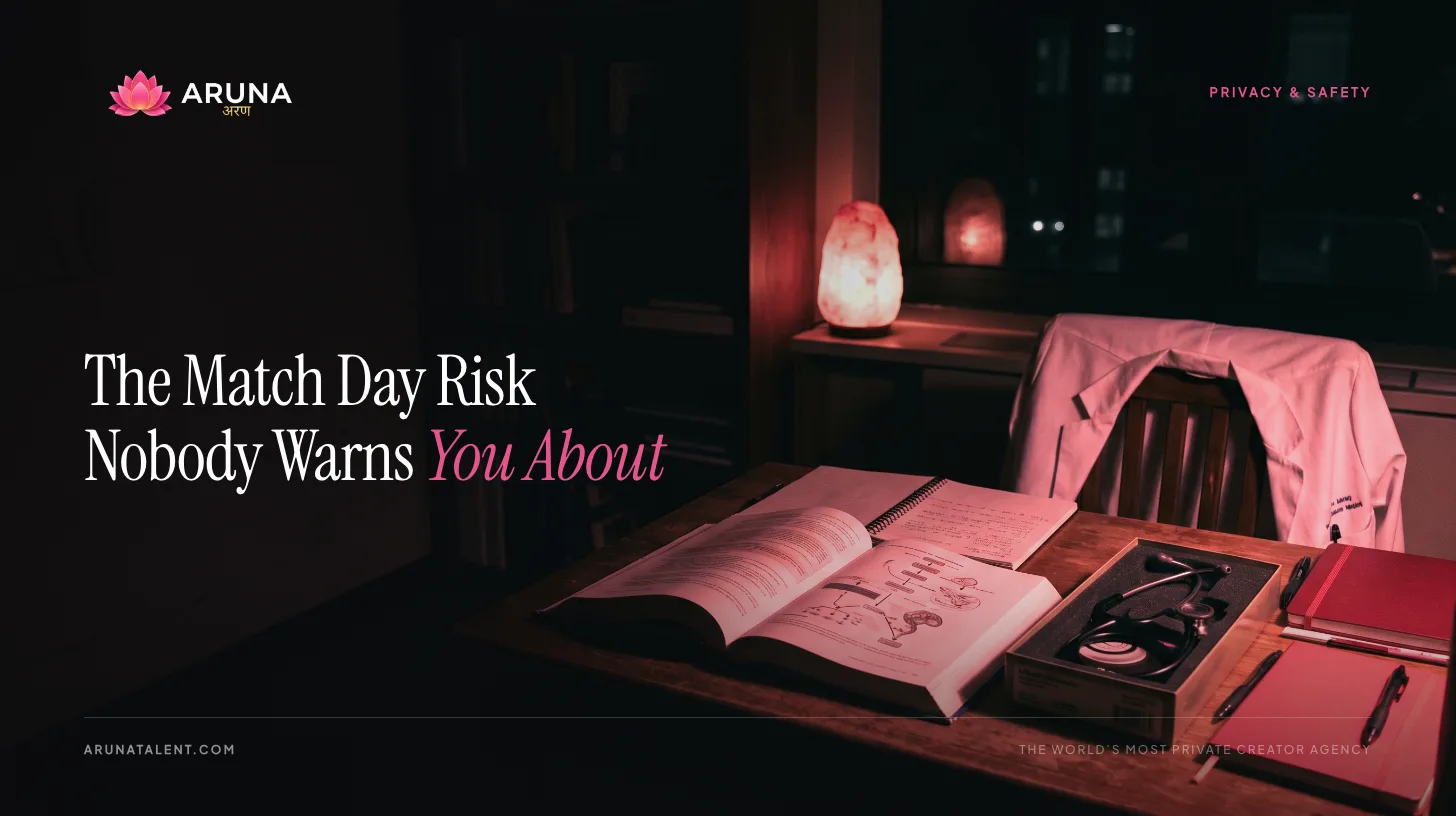
Medical school is one of the most expensive professional educations available. The average student graduates with $200,000–$250,000 in debt, earns nothing during four years of training, and then enters residency earning $60,000–$65,000 per year, often in high cost-of-living cities, while managing six-figure debt and working 60–80 hours per week.
The financial calculus of medical school creates a situation where supplemental income isn’t a luxury. For many students, it’s a survival question. OnlyFans has become a real income source for creators at every stage of life, and medical students are among them. But medical school creates a risk profile unlike almost any other environment a creator can be in: a rigorous professionalism framework, a high-recognition clinical environment, a multi-decade licensing system, and a residency matching process that puts enormous discretion in the hands of individual program directors.
This guide covers every medical-school-specific risk, the complete identity protection framework you need before posting anything, and the income math that makes it worth understanding carefully.
Why Medical School Is a Unique Risk Environment
Most OnlyFans privacy guides apply a general framework: stage name, VPN, geoblocking, separate email, done. That framework is necessary but not sufficient for medical students, because the risk environment has properties that require additional layers.
Professionalism Is Institutionally Enforced
Medical schools require students to sign professionalism agreements. These codes are deliberately broad. Language like “behavior inconsistent with the standards of the medical profession” or “conduct unbecoming a physician” is designed to give institutions discretion over a wide range of situations. This language has been used, though rarely, to address legal off-campus activities that became publicly known.
The key phrase is “publicly known.” A creator with a complete alias and no discoverable connection to their medical school enrollment is not in the same risk category as one whose real name can be found through a basic search. The conduct code is most dangerous when identity is exposed, not when it isn’t.
The NBME and USMLE Character Standards
The United States Medical Licensing Examination process includes character and fitness standards administered by the National Board of Medical Examiners. The NBME doesn’t proactively search social media or OnlyFans, but they do respond to formal complaints and investigate conduct concerns surfaced through institutional channels.
The licensure process spans your entire career. State medical boards conduct character and fitness reviews at initial licensure, at each renewal cycle, and in response to complaints, and they have jurisdiction over your license for as long as you practice. A conduct issue documented during medical school creates a reportable event that follows you through every licensure application, every credentialing process, and every hospital privileging review for the duration of your career.
This is what makes the medical student risk profile different from almost any other professional context: the time horizon is decades, not years.
The Match Process
The residency Match is the single most consequential application process in a medical student’s career. Program directors and department chairs have significant discretion, and they use it. They search applicants. They Google names. They check social media. They ask colleagues at other institutions about candidates.
A discoverable OnlyFans, one where your real name is connected to creator content through any search path, is a Match risk. This isn’t speculation: program directors openly discuss screening applicants for professional conduct, and content creation is explicitly mentioned in conversations about fitness for residency.
The protection is preventing discoverability. A creator identity with no digital bridge to your real name cannot be found through a Google search of your name, a social media search, or a reverse image search of your professional photos.
Mapping the Specific Risks
Medical School Program Dismissal
Medical schools have Academic Progress Committees and Professional Standards Committees that review conduct concerns. Dismissal from a medical school program is rare, but it does happen, and professionalism violations are among the stated grounds.
The critical variables for an OnlyFans creator are:
- Whether your real identity is discoverable through your creator presence
- Whether content was created using medical school resources (facilities, equipment, networks)
- Whether a formal complaint is filed that triggers an official review
Informal discovery (a classmate who knows and doesn’t report) is a different situation than a formal complaint that initiates a process. The conduct committee process is investigative and operates with less procedural protection than judicial proceedings. Once a formal process starts, outcomes are harder to predict and control.
Protection: Identity separation prevents the formal complaint pathway. If your real name cannot be confirmed as the creator, there is no basis for a formal conduct complaint.
USMLE Step Exams and NBME Fitness Review
USMLE Steps 1, 2, and 3 all involve registration with the NBME. The NBME can flag candidates for character review and delay or deny examination eligibility pending investigation. This is rare and typically triggered by documented misconduct (criminal history, academic dishonesty, prior conduct actions) rather than by legal off-campus activity.
The risk for OnlyFans creators specifically is downstream from a medical school conduct action. If your school takes disciplinary action, that action can become a reportable event in USMLE applications. The medical school conduct action is the risk; the NBME and USMLE exposure follows from it.
Clinical Rotation Recognition: The M3/M4 Risk
The transition from pre-clinical (M1/M2) to clinical (M3/M4) is the most significant risk escalation in a medical student’s OnlyFans career. Before clinical year, your face is primarily known to your classmates and school administration, a relatively contained group. Clinical year adds:
- Attendings: faculty physicians who supervise you and have direct reporting lines to program directors
- Residents: post-graduate physicians embedded in the same department culture
- Nurses and clinical staff: a large population who interact with you regularly in clinical settings
- Patients: individuals from the broader community who may recognize creators from any online platform
Any of these individuals discovering your content while you’re on their rotation creates a clinical environment crisis. The power dynamic with attendings in particular (they write your clinical evaluation letters and can affect your MSPE) makes recognition by an attending one of the more serious discovery scenarios.
Hospital white coat and stethoscope as identifiers. These are among the most recognizable props in any visual content. A white coat in a single frame is sufficient to identify you as a medical professional. A stethoscope is the same. These items never appear in creator content.
Protocol for clinical years: No content created on clinical rotation days. Shoot only on days you are not at a clinical site. Remove any item of medical professional identity (white coat, stethoscope, hospital badge, scrubs) from your shooting environment entirely.
Class Cohort Dynamics
Medical school classes run 150–200 students. Four years together, same curriculum, same clerkship rotations, same social events, same WhatsApp groups. This is a smaller and more intimate community than most undergraduate environments.
Medical student culture has specific social dynamics: highly competitive, high-stakes, and with a strong investment in the professional identity of “physician-in-training.” Discovery within your class creates a social environment where you have limited ability to control information flow once it starts.
The cohort dynamic also means that one disclosure event can reach the entire class quickly. If a classmate discovers your OnlyFans and chooses to share it, the information can move through the entire cohort within hours.
Protection: Faceless content with complete identity separation means a classmate who suspects something cannot confirm it without your admission. “That’s not me” is a defensible position when your content has no identifiable face and no details that uniquely connect to you.
State Medical Board Licensure
State medical board licensure applications ask about criminal convictions, disciplinary actions, and conduct violations. They do not ask about legal off-campus activities. The risk materializes through two pathways:
- A medical school conduct action creates a reportable event that must be disclosed in licensure applications
- A formal complaint is filed with a state medical board during residency or practice, triggering an investigation
Both pathways require your real identity to be known and a formal process to be initiated. Neither is triggered by anonymous content that cannot be traced to your real name.
The long tail: State medical boards have jurisdiction for the duration of your license. Content created during medical school can theoretically surface decades later. This is not a reason to avoid creating content. It is a reason to build identity protection that persists over time, which means ensuring your creator identity has no permanent linkage to your real name anywhere online.
Hospital Credentialing
After residency, hospital credentialing is a separate review process conducted by hospital medical staff offices. Credentialing reviews typically include background checks, license verification, malpractice history, and reference checks. Some credentialing processes include social media review.
This is a downstream risk, affecting you at the stage of attending physician practice, but it is shaped by decisions made during medical school. Identity protection implemented now carries forward.
Residency Application: Program Directors Search
This deserves its own emphasis beyond the Match section above.
Program directors conduct informal searches of applicants as a routine part of the selection process. A discoverable OnlyFans doesn’t disqualify you formally (there is no official mechanism for this) but it does create a subjective impression that affects interview invitations and rank list placement.
The standard is not whether a program director could overlook it. The standard is whether they need to know at all. A creator identity with no searchable connection to your real name means no program director ever faces the decision.
The Income Math
Medical students carry an average of $200,000–$250,000 in educational debt at graduation. During medical school, the typical income is zero, or near-zero if clinical payment varies.
Residency salaries average approximately $60,000–$65,000 per year, with higher costs of living in major academic medical centers. The debt-to-income ratio during residency is painful by any financial measure.
Creator income changes this picture in material ways:
- $2,000/month during medical school eliminates roughly $24,000 in additional borrowing per year, or $96,000 across four years. At current medical school loan interest rates, the downstream interest savings are significant.
- $5,000/month covers living expenses and avoids borrowing for day-to-day costs entirely.
- $8,000–$15,000/month at the higher end of managed creator performance changes the debt calculus of medical school completely.
For creators who start early and build consistently, the income during M1–M2 (pre-clinical, lower risk) can generate substantial savings before the higher-risk M3–M4 clinical years require more conservative operations.
The Complete Identity Separation Framework
This is built before any content goes live, not assembled in response to a problem.
Before You Post Anything
Creator email. Open a ProtonMail or Tutanota address with no connection to your name, your medical school, or any existing account. This address registers for every creator platform, tool, and service.
Stage name. Your creator name has no connection to:
- Your real name or any variation
- Your medical school’s name, location, or nickname
- Any specialty, rotation, or medical term that narrows your identity
- Your geographic location
Social accounts. TikTok, Instagram, Twitter/X, Reddit: all created under the stage name, with the creator email, on a separate browser profile or separate device.
VPN. Active on every creator-related session. NordVPN, ExpressVPN, or ProtonVPN. Never access creator accounts without it.
Banking. A dedicated bank account (Novo or Relay work well) for all creator income and expenses. Completely separate from personal and school-related finances.
Separate device. A dedicated device for creator work is the gold standard for medical students. If a separate device isn’t feasible, a strictly separated browser profile (never the same profile used for school systems or personal accounts) is the minimum.
Platform Configuration
Geoblocking. Block your home state and any state where you have or will have clinical rotations. If you’re doing away rotations for residency applications, consider blocking those states during that period.
Username and bio. No medical terms, no specialty references, no language that positions you as a healthcare professional of any kind.
Content Rules Specific to Clinical Years
Medical-environment content rules must be absolute, not aspirational:
- No white coat, ever, in any content, under any framing
- No stethoscope or clinical equipment. These are immediate visual identifiers of medical professionals
- No scrubs, recognizable from clinical environments
- No hospital badge, lanyard, or institutional identifier
- No content created on clinical days. Shoot only on non-rotation days, after you’ve separated from the clinical environment
- No shooting at or near clinical sites. The distance between a hospital and your shooting location should be significant enough to eliminate ambient audio and location data risk
- Neutral, generic backgrounds, with no medical textbooks visible, no anatomy charts, no clinical reference materials
After Each Rotation Cycle
Conduct a periodic audit:
- Search your stage name plus your real name to check for any emerging digital connection
- Reverse image search any content featuring your face against your professional photos
- Review your creator social accounts for any detail that has drifted toward the medical-professional aesthetic
- Update geoblocking if your rotation geography has changed
M1/M2 vs. M3/M4 Strategic Approach
Pre-clinical years (M1/M2) are the window of lower risk. You’re not in clinical settings, your face is known primarily to classmates and administration, and your daily schedule is more predictable. Many medical student creators build their subscriber base and income during pre-clinical years when the operational risk is lower.
A creator who starts in M1, builds consistently through M2, and reaches $5,000–$10,000/month by the time M3 begins has more flexibility about how aggressively they operate during clinical years. The financial stability from pre-clinical income provides a buffer that allows more conservative clinical-year operations.
Clinical years (M3/M4) require heightened protocol. The recognition surface area expands dramatically. Many creators reduce content volume during clinical rotations and increase it during weeks off. Faceless content during clinical years is the conservative and often sensible choice.
The strategic framework: build aggressively during pre-clinical years when risk is lower, and operate conservatively during clinical years when the recognition surface is highest.
Working With an Agency as a Medical Student
Medical school is one of the most time-intensive programs a professional can undertake. Adding a solo OnlyFans operation (content creation, social media management, subscriber engagement, promotion, DMCA monitoring, analytics, tax tracking) to that load is unsustainable for most students.
Aruna Talent’s model compresses the creator time commitment to content production only. The agency handles social media management, promotion strategy, subscriber engagement, and growth operations. For a medical student, this means creator income without the operational burden of running a creator business.
Aruna also builds and maintains the complete privacy architecture: alias systems established before the first piece of content, geo-blocking applied on request where it makes sense for you, all creator social accounts managed under the alias, and a four-plus-year track record of zero identity leaks across our creator network.
For healthcare students specifically, we advise on medical-environment content rules, rotation-schedule-aware content planning, and the specific identifiers that create risk in clinical settings. This institutional knowledge about healthcare student privacy is not something general creator guides address.
Apply to work with Aruna Talent →
FAQ
Can medical school dismiss me for having an OnlyFans?
Yes, this is a real risk. Medical schools have professionalism codes with broad conduct provisions that can extend to off-campus activity if it’s deemed inconsistent with the standards of the profession. The key variable is whether your creator identity can be linked to your real name and enrollment. A creator with a complete alias, no identifiable face in content, and zero digital connection to their medical school has dramatically lower exposure than one who can be traced.
Does the NBME review OnlyFans content for USMLE Step exams?
The NBME conducts character and fitness reviews and can investigate conduct concerns raised during the licensing process, but they don’t proactively search social media or OnlyFans. The risk materializes if someone files a formal complaint, if your identity becomes publicly known, or if a state medical board inquiry begins during residency or licensure. The long-tail nature of this risk (boards have jurisdiction for decades) means protection decisions made in medical school carry consequences through your entire career.
Will having an OnlyFans affect my residency Match?
Program directors and department chairs search applicants extensively, and a discoverable OnlyFans is a Match risk. The realistic path to protection is a creator identity that cannot be found through a search of your real name: no Google results, no social media cross-referencing, no image-match results. Aruna Talent builds identity systems specifically designed to eliminate search-discovery risk. Creators in our network applying to residency do so without a discoverable connection between their real name and creator work.
Is M3 or M4 (clinical year) significantly riskier than M1 or M2?
Yes, significantly. Pre-clinical years involve less face time with attendings and no patient contact, so the discovery vectors are primarily your classmates and school administration. Clinical years add attendings, residents, nurses, and patients, a much larger audience of people who see your face regularly and operate in a professional context where professionalism standards are actively enforced. Recognition risk during clinical rotations is the most acute risk medical student creators face.
What happens if a patient or attending recognizes me during a rotation?
A patient who recognizes you during a clinical rotation creates an uncomfortable situation but isn’t automatically a conduct matter. An attending who recognizes you and reports it to the program director is a conduct matter. The nature of the recognition determines the response, but the protective move is preventing recognition entirely. Faceless content eliminates this vector completely. If your content has no identifiable face, attendings and patients cannot confirm it’s you regardless of what they suspect.
Can OnlyFans income realistically help with medical school debt?
Yes. The average medical student graduates with $200,000–$250,000 in debt. At the bottom of residency pay ($60,000–$65,000/year), the debt-to-income ratio is painful. Creator income ranging from $2,000–$8,000/month during medical school changes the debt picture materially, whether used to avoid additional borrowing, make interest payments during school, or build a buffer before residency begins. The income potential is real; the protection infrastructure is what makes it viable.
How does state medical board licensure affect my risk as a medical student?
State medical boards conduct character and fitness reviews as part of the licensure process. Most ask about criminal history, disciplinary actions, and conduct violations, not about legal off-campus activities. The risk is if a formal disciplinary action has been taken by your medical school, which then creates a reportable event in licensure applications. Preventing the disciplinary action through proper identity protection is the primary strategy. Completed conduct actions are far harder to manage than prevented ones.
What does a complete identity separation framework look like for medical students?
Before any content goes live: a complete alias with zero connection to your real name, a dedicated creator email, all social media under the alias, geographic blocking for your home state and any state where you have clinical rotations, and a separate device for all creator activity. During clinical years: no content created in or near clinical settings, no scrubs, white coats, stethoscopes, or medical paraphernalia in any content, and no shooting on days when you’re recognizable from a rotation. Aruna Talent builds and maintains this infrastructure for every managed creator.
For the full privacy setup sequence, see our OnlyFans privacy checklist. For a full overview of what professional creator management includes, visit the OnlyFans management page.
The Protection Infrastructure Comes First
Medical school is one of the highest-stakes professional environments for a creator to operate in. The risk is real, the consequences are long-lasting, and the standard privacy advice doesn’t go far enough.
But the risk is manageable. Creators at Aruna Talent who are medical students or healthcare professionals operate with a complete privacy architecture that has produced zero identity leaks over four-plus years. The infrastructure is the difference between a sustainable income source and an exposure event that affects a 30-year career.
Build the protection first. Then build the income.
Ready to take your content career seriously?
Apply in a few minutes. No upfront cost. No obligation. Not ready? The free Creator Kit gets you started on your own terms.
60+ creators · $10M+ annually total revenue
You Already Know What's Possible. Now Find Out If It's Possible for You.
$20K+ your first week, that's our target, backed by 60+ launches. No followers needed. Your real name, family and location stay private, and a dedicated team drawn from a company of 100+ runs your growth. The only question is whether you apply.
See If You Qualify →No upfront cost · No obligation
How Aruna Can Help