Nursing Student on OnlyFans: Clinicals, Program Risk, and Full Privacy Guide
Aruna Talent Team
Creator economy experts · $10M+ annually total creator revenue
You are juggling two demanding roles at once. Nursing school is one of the most intensive academic programs in existence (clinicals, pharmacology, simulation labs, NCLEX prep), and you are also trying to build financial independence before your degree is even in hand. That combination is not impossible to manage. But the risks for nursing students specifically are higher and more varied than for most other professionals considering OnlyFans, and most of the guides online were not written with your specific exposure surface in mind.
This guide covers the full landscape: program dismissal risk, the clinical rotation problem, the licensure process, and what a working privacy framework actually looks like for someone in your position.
Why Nursing Students Are a Special Case
Most profession-specific privacy guides focus on employment risk: will your employer find out? For nursing students, the risk architecture is different. You have not yet crossed the threshold into professional licensure. That means the entities with the most power over your future are not yet an employer. They are:
- Your nursing school and its academic conduct standards
- Your clinical rotation sites and their affiliated hospital systems
- Your state board of nursing and the character and fitness review it conducts before issuing your RN license
Each of these represents a distinct discovery pathway, and each operates differently. Understanding them separately is the foundation of an effective privacy strategy.
Program Dismissal: The Conduct Code Problem
Nursing programs routinely require students to sign professional conduct agreements that extend well beyond academic performance. These codes typically include language about maintaining the dignity of the profession, social media conduct, and behavior that could bring discredit to the program or the nursing profession broadly.
Courts have generally been deferential to private institutions in particular when it comes to enforcing these codes against students. Public universities carry more due process obligations, but even there, programs have succeeded in dismissing students for off-campus conduct when they can articulate a nexus to professional fitness.
What this means practically: if a faculty member, classmate, or clinical supervisor discovers your account and files a complaint with your program’s academic affairs office, you may face a formal conduct review. The outcome of that review depends on your specific institution, the specific language of your conduct code, and how your administration chooses to interpret it. Some programs will dismiss students outright. Others may issue formal warnings. A few may not act at all. You cannot know in advance which category your program falls into.
The safest position is that your program never has occasion to find out. That requires complete identity separation, not just using a different name, but ensuring no discoverable link exists between your creator persona and your legal identity as a nursing student.
The Clinical Rotation Problem
This is the risk that most guides miss entirely, and it is the most operationally difficult to manage.
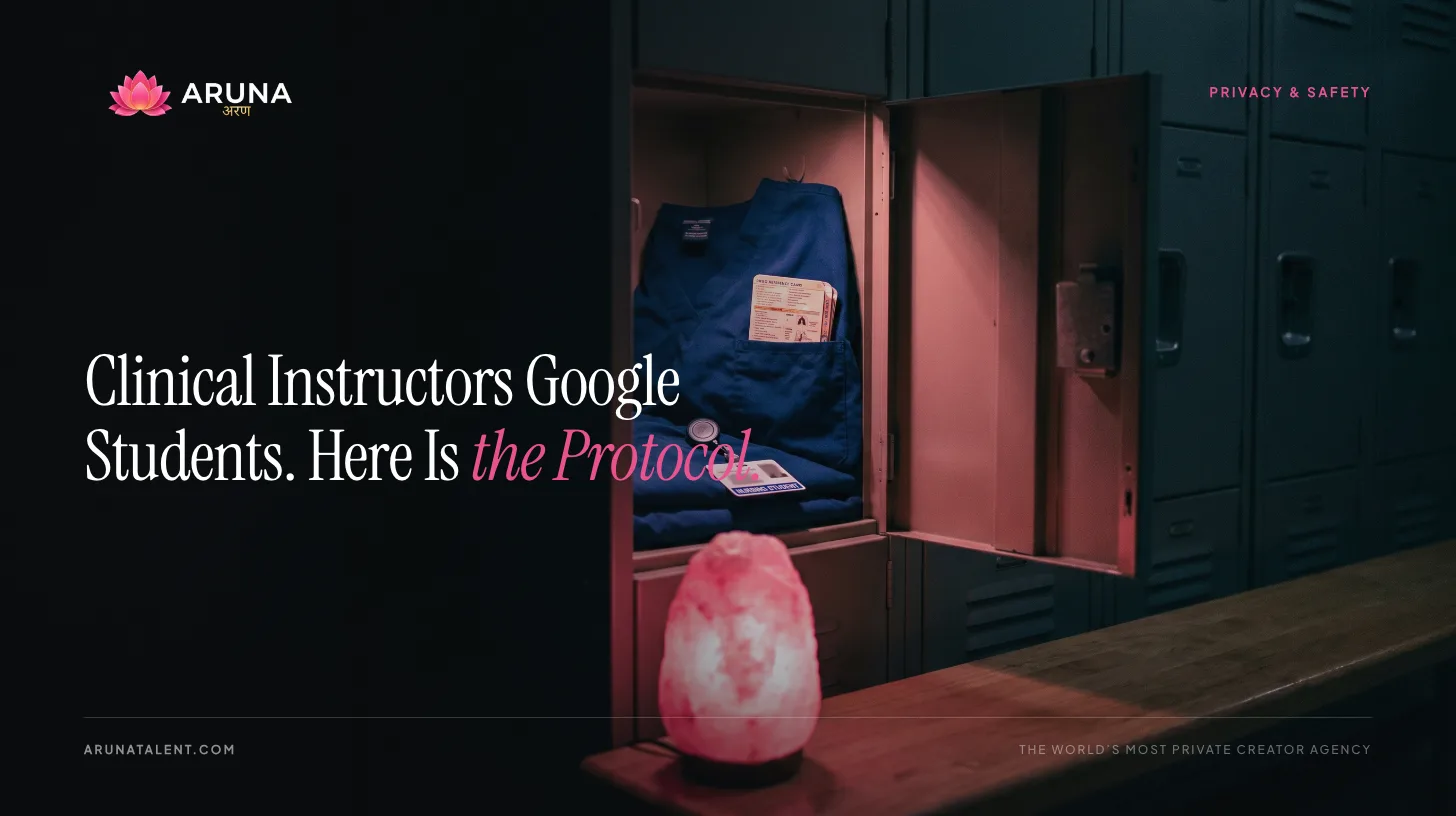
During clinical rotations, you are present in active healthcare facilities: hospitals, long-term care facilities, outpatient clinics, surgical centers. You are typically wearing scrubs, and you are wearing a badge that displays your full legal name and your nursing program affiliation.
Patients in those facilities are members of the general public. You cannot screen who they are before you enter their room. A patient who subscribes to your content, or who has seen screenshots circulated on social media, can identify you from your name badge alone. They do not need to know your stage name. They do not need to see your face alongside any creator account. They see you in person, recognize you, and your legal name is pinned to your chest.
If that patient reports the recognition to the clinical site (to a nurse manager, a charge nurse, or a clinical educator), the facility may contact your program. Clinical sites have the authority to remove students from their rotations for any reason. A single removal from a clinical site can halt your progression through the program, because clinical hours are non-negotiable requirements for graduation.
The implication is that your privacy infrastructure needs to work at scale, across whatever population of people might be patients at every facility where you rotate. This is not a small number. Geo-blocking your local area helps reduce the overlap between your subscriber base and your patient population, but it does not eliminate it.
Clinical Site Employers and Supervisor Discovery
Your clinical supervisors are employees of the hospital systems where you rotate. Those hospital systems are major regional employers. If a supervisor discovers your account, they face a professional decision: do nothing, report to the clinical education coordinator, or contact your nursing program directly.
Clinical supervisors are not neutral observers. They are licensed nurses or advanced practice providers who have professional obligations of their own, and many will feel compelled to act on a discovery. The personal opinion of any individual supervisor matters less than the institutional pressure they operate under.
Additionally, if you are later hired by a system where you rotated, people who were your supervisors during clinicals may now be your colleagues or managers. A discovery that did not result in action during your student years can resurface in an employment context years later.
The NCLEX and Nursing Board Character Review
When you apply for your RN license after passing the NCLEX, your state board of nursing conducts a character and fitness review. The scope of that review varies by state, but it typically includes disclosures about criminal history, prior disciplinary actions by academic institutions, and prior professional licensing actions in other states.
If your nursing program took formal disciplinary action against you (even if you were not dismissed), that may need to be disclosed. If you were dismissed and later reinstated, that almost certainly needs to be disclosed. If a complaint was filed against your nursing license application in another state (rare during the student phase, but possible if clinical supervisors filed complaints through professional channels), that also surfaces.
The character and fitness review is not designed to catch OnlyFans creators. But the pathway where discovery leads to a program disciplinary action, which creates a record, which surfaces during board review, is a real one. Eliminating the discovery eliminates the chain.
Faculty Discovery in Small Cohort Programs
Nursing cohorts are small by design. Many programs admit 40 to 80 students per class year. You share the same professors across multiple semesters. Your clinical instructors see you week after week. Faculty advisors often have personal investment in the students they supervise.
This social density creates a different discovery dynamic than it would in a 500-student lecture course. Your faculty know your name, your face, and often details about your personal circumstances. They may follow regional social media. They may recognize you from a third-party account that reposts content. They may hear about your account from a classmate.
A faculty member discovery in this environment is more likely to lead to a formal response than an anonymous tip to an HR department at a large employer. Faculty often feel a professional responsibility that translates into action.
Visual Identifiers to Eliminate
The most preventable category of discovery involves content that inadvertently includes identifiable elements from your clinical or academic life. These identifiers are more dangerous than face exposure in some ways, because they are searchable and cross-referenceable.
Never include in any content:
- Name badges from hospitals, clinics, or your nursing program
- Scrubs with facility logos, unit names, or department identifiers
- Stethoscopes or equipment with visible identifying tags
- Nursing program apparel, lanyards, or branded items
- Clinical or hospital environments as backgrounds: nurse stations, patient rooms, hallways with visible signage
- Campus buildings or university-specific visual elements
Even content filmed in a neutral home environment can carry risk if items visible in the background link back to your program or clinical sites.
The Pre-Licensure Window
The period from your first day of nursing school through the day your state board issues your RN license is your window of maximum vulnerability. During this window, you are subject to program conduct codes, clinical site policies, and board character review simultaneously.
Post-licensure, your exposure shifts primarily to employment. Your employer can terminate you for conduct violations. In some states, your employer can file a board complaint that triggers a license review. But the acute risk of losing the ability to enter the profession at all is lower once you have crossed the licensure threshold.
Many creators in professional programs use the pre-licensure period exclusively for infrastructure setup: establishing the LLC, creating the stage name and brand, building the technical privacy stack, and planning content strategy, without actually publishing anything. They launch immediately after licensure. This approach captures most of the income opportunity while concentrating exposure in the window where they have the most control over it.
Income Realities and Student Loan Context
The average nursing student graduates with $30,000 to $80,000 in student loan debt, depending on program type and institution. RN starting salaries range from $55,000 to $85,000 in most markets, with higher figures in specialty areas and high cost-of-living regions.
A creator generating $3,000 to $8,000 per month from OnlyFans while working as an RN is meaningfully accelerating their debt payoff timeline or building savings that would otherwise take years to accumulate. That income potential is real and worth protecting with a serious privacy infrastructure.
The mistake is allowing income pressure during school to shortcut privacy steps. A creator who launches prematurely, before the LLC is set up, before the stage name is fully compartmentalized, before geo-blocking is configured, creates exposure that can cost them the career they are building the income to support.
Aruna’s Privacy Framework for Nursing Students
At Aruna, we work with student creators to build privacy infrastructure that holds up under the specific pressures of professional programs. The framework includes:
Stage name architecture. Your creator name has no phonetic or visual resemblance to your legal name. It does not incorporate your program, specialty area, or location. It is not searchable in ways that connect to your academic identity.
Payment and tax routing. Income flows through a business entity (typically an LLC) so your legal name does not appear on tax documentation linked to the platform. This prevents the financial paper trail from creating a connection between your creator income and your identity.
Geographic isolation. On request, where it makes sense for you, we configure geo-blocking to remove your school region, your clinical rotation areas, and your home address location from your subscriber pool. This does not eliminate clinical site risk, but it substantially reduces the overlap between your likely patient population and your subscriber base.
Content review protocols. Before any content publishes, it goes through a review process designed to catch inadvertent identifiers: backgrounds, equipment, apparel, location metadata in images.
Ongoing monitoring. Third-party sites frequently scrape and redistribute OnlyFans content. We monitor for unauthorized distribution and issue DMCA takedowns to prevent your content from reaching platforms where facial recognition or reverse image search is more easily applied.
If you are in a nursing program and considering OnlyFans, the first step is a privacy audit before you take any other action. Aruna offers those consultations to help you understand your specific exposure surface and build the infrastructure that fits your situation.
Building this alone caps how far it goes. Aruna Talent runs content strategy, daily fan messaging, growth, and privacy protection for 60+ creators. See if you qualify →. It takes about a minute, and a straight no is a useful answer too.
Ready to take your content career seriously?
Apply in a few minutes. No upfront cost. No obligation. Not ready? The free Creator Kit gets you started on your own terms.
60+ creators · $10M+ annually total revenue
You Already Know What's Possible. Now Find Out If It's Possible for You.
$20K+ your first week, that's our target, backed by 60+ launches. No followers needed. Your real name, family and location stay private, and a dedicated team drawn from a company of 100+ runs your growth. The only question is whether you apply.
See If You Qualify →No upfront cost · No obligation
How Aruna Can Help