Hairstylist on OnlyFans: License Risk & Anonymity
Aruna Talent Team
Creator economy experts · $10M+ annually total creator revenue
Last updated: May 28, 2026
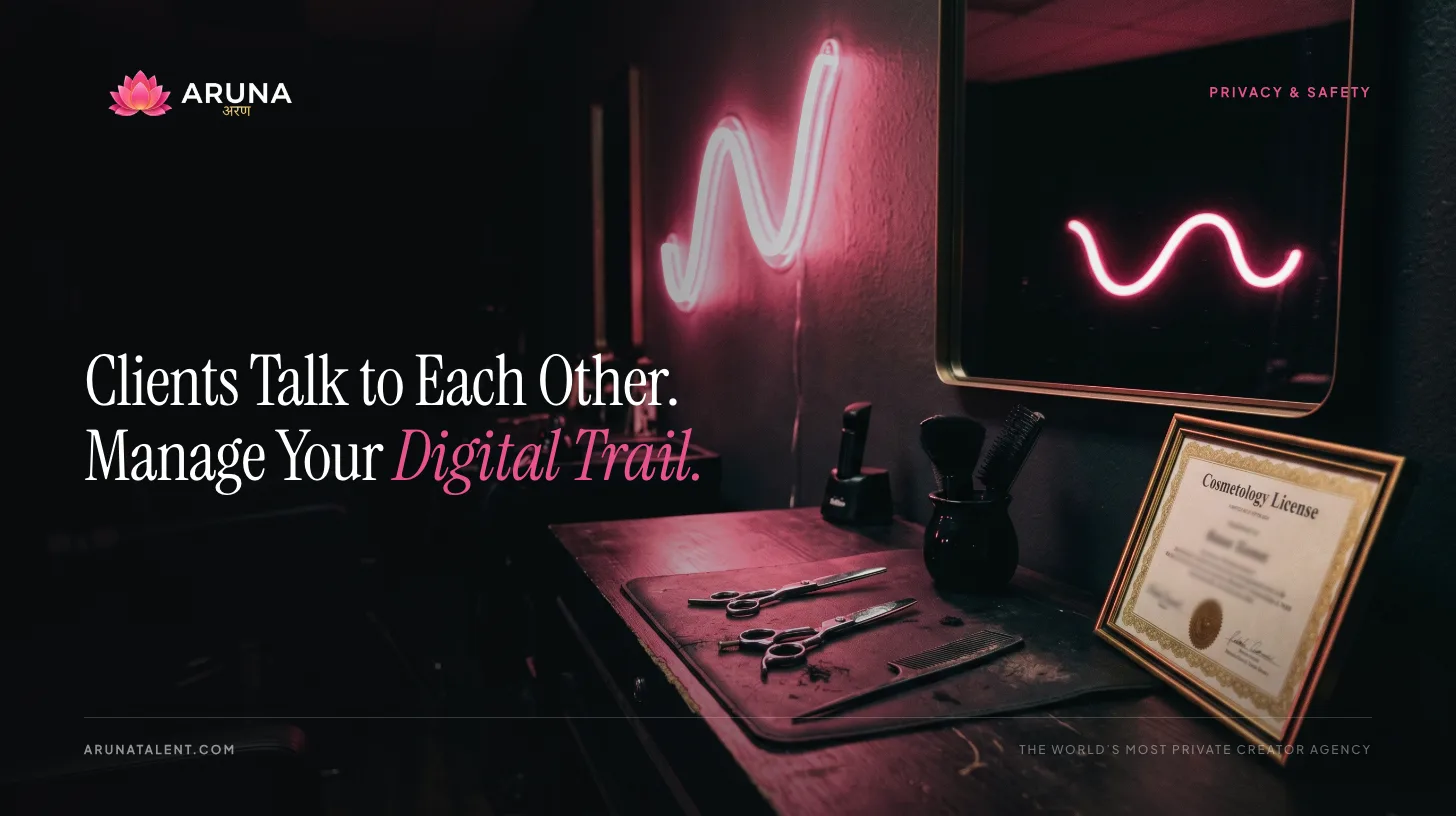
Hairstylists occupy a unique position in the OnlyFans risk landscape. The professional rewards are real: independent income, flexible content creation that complements a creative career, and a built-in visual portfolio instinct that translates naturally to content production. The risks are also specific and worth understanding before starting, because the cosmetology profession has characteristics that most risk guides don’t account for.
The most important one: hairstyling is among the most Instagram-forward professions in existence. A significant professional social media presence isn’t unusual for stylists. It’s the standard way business is built. That professional visibility changes the identity protection calculus in ways that matter.
State Cosmetology Licensing Boards
Cosmetology licensing in the United States is governed at the state level. The National-Interstate Council of State Boards of Cosmetology (NIC) administers national licensure examinations and sets competency standards, but enforcement authority belongs to each state’s board. The content of state cosmetology practice acts varies, and so does the breadth of conduct provisions.
Most state cosmetology boards are focused on narrow professional matters: sanitation practices, chemical application safety, supervision requirements, and consumer protection. These boards exist primarily to regulate the practice of cosmetology in licensed settings, not to police licensees’ lawful off-duty activities.
That said, many state practice acts contain broad language (phrases like “moral turpitude,” “conduct unbecoming a licensed professional,” or “acts reflecting adversely on the profession”) that could theoretically be applied to adult content creation. The operative word is theoretically. Documented instances of cosmetology board action specifically against adult content creators are rare. The investigative mechanism requires the same trigger that applies to any professional board: a formal complaint from someone who has connected your professional identity to your creator identity. Anonymous content doesn’t trigger board review. Identified content does.
Research your specific state board’s conduct provisions before starting. The practical licensing risk for hairstylists is low relative to more formally regulated healthcare and legal professions, but it is not zero in states with the broadest conduct language.
Employer and Business Structure Risk
The employment structure you work in shapes your exposure significantly.
Corporate chain employees at Great Clips, Supercuts, Sport Clips, Drybar, Aveda, Regis Salons, and similar chains face the most formal employer risk. These organizations have brand standards, conduct policies, and HR departments. Discovery of an OnlyFans account, typically through a client complaint, a colleague report, or a management observation, can result in termination through formal HR processes. The specific language of your employment agreement matters: conduct clauses, social media policies, and outside employment provisions all vary by company and may have been updated.
Independent booth renters are self-employed contractors. There is no employer conduct policy in the traditional sense, but the salon owner whose space you rent can decline to renew your rental agreement for any reason, including discovering content they find inconsistent with their salon’s brand. No HR process, no formal investigation, just a conversation that ends your access to the space. In markets where desirable booth locations are competitive, this is a meaningful risk.
Salon owners operating their own business face a different exposure. The employer risk is eliminated. The risk that replaces it is reputation-based: a salon owner whose personal identity becomes publicly connected to an OnlyFans account faces potential consequences with clients, with product vendors, with commercial landlords, and in community standing in ways that flow back to the business. In smaller markets, this exposure is more acute.
The Client Recognition Factor
Salon relationships are among the most intimate recurring professional relationships in any service industry. Clients return every four to eight weeks, often for years. They talk openly about their lives, their families, their relationships, in ways that create genuine familiarity. They know their stylist’s voice, laugh, mannerisms, and appearance in significant detail.
This is the primary discovery vector for hairstylists, and it operates differently from most professional fields. A client who encounters a creator’s account doesn’t need to see a name or location. They may recognize the person immediately and with high confidence based on appearance and voice alone. Geographic blocking of your salon’s surrounding area reduces the chance that current clients discover the account through platform searches, but it doesn’t prevent discovery if a client encounters content shared elsewhere or searches outside the blocked region.
The intimacy of the salon relationship also affects what happens after discovery. A long-term client who recognizes their stylist faces social awkwardness that can push them toward a quiet exit rather than a formal complaint, but the community-sharing dynamic of salon culture means word can still travel. In small and mid-sized markets, salon social networks are tight.
The Hairstylist Social Network Risk
This is the risk factor most specific to cosmetology, and it is frequently underestimated.
Hairstyling is one of the few professions where building a large Instagram following is a standard and expected part of career development. Many working stylists have thousands of followers, sometimes tens of thousands, on professional accounts that showcase their work under their real name, with their face, in their salon. These accounts include detailed visual records of their appearance, regularly updated as styles and looks change.
This professional Instagram presence creates a specific compounding problem. The followers of a stylist’s professional account are the exact demographic most likely to discover their creator content. Those followers are already familiar with their appearance, vocal cadence, and aesthetic. A subscriber who also follows the professional Instagram can make an identification with a level of confidence and speed that a stranger couldn’t.
The risk extends beyond followers. Other stylists and cosmetologists follow each other’s professional accounts throughout their careers. Industry contacts, brand representatives, and salon owners are active on professional Instagram. The professional network is socially dense. Information shared with one person has a realistic path to reaching others quickly.
The answer is not to abandon a professional Instagram. It is the engine of client acquisition in this profession and shouldn’t be sacrificed. The answer is to build a creator identity that is visually, contextually, and nominally completely distinct from the professional brand, and to maintain zero operational connection between them.
Hairstylist-Specific Content Environment Risks
The salon environment is uniquely identifiable, and this is the most controllable risk variable.
Salon chairs are distinctive: the shape, recline mechanism, and footrest configuration are immediately recognizable. Shampoo bowls, styling station mirrors with theatrical lighting, color mixing areas, chemical processing stations, and the specific layout of a professional salon space are all recognizable to clients who visit that environment regularly. Clients who frequent a salon know what their stylist’s station looks like.
Product placement creates additional risk. Professional salon brands (Olaplex, Wella, Schwarzkopf Professional, Redken, Kenra, Pravana) are not found in most residential settings. A visible product label on a shelf or counter immediately signals a professional salon context to anyone familiar with the industry. Styling tools (specific shear brands, professional dryers, color application brushes, foil dispensers) carry the same signal.
Branded salon clothing and aprons are an obvious risk, but the subtler one is the fluorescent or vanity lighting characteristic of salon workspaces. Even a neutral backdrop with salon-specific lighting can register as a salon environment to a perceptive viewer.
All content should be produced in a residential setting with no professional salon identifiers. This is categorical.
Identity Protection Framework
Professional Instagram firewall. This is the highest-priority action for hairstylists specifically. Your professional Instagram and your creator accounts must share zero followers, zero cross-references, zero similar visual language, and zero geographic or naming connections. They exist in completely separate operational contexts. Never log into both sets of accounts in the same session on any device.
Pseudonym construction. Your creator name has no connection to your real name, your salon, your city, or your professional Instagram handle. No variations, no shared initials, no inside references to your professional work. Generate something entirely new and search it across all platforms before using it.
Environment control. All content is produced outside any salon environment. No styling chairs, no shampoo bowls, no product shelving, no professional tools, no branded clothing or aprons. Neutral residential setting only.
Geographic blocking. Configure blocking for your salon’s zip code, your home neighborhood, and the surrounding service area before any content goes live. This closes the most direct discovery pathway for current clients.
Physical distinctiveness audit. Review your professional Instagram and other public-facing photos. Identify any distinctive physical features (hair color, tattoos, birthmarks, piercings) that appear in both your professional images and your content. The more your professional social media showcases your appearance, the more carefully your creator presentation needs to be differentiated.
Separation infrastructure. Dedicated email address, separate payment account, device hygiene that prevents social media platforms from suggesting cross-account connections. These are standard and non-negotiable.
How Aruna Talent Supports Licensed Professionals
Aruna Talent manages creators across professional backgrounds, including licensed cosmetologists and hairstylists where professional social media exposure, employer discovery risk, and client recognition create a specific management challenge.
For hairstylists, the agency’s infrastructure addresses the vectors that matter most. Fake name systems and identity construction are handled before any content goes live. Geographic blocking is configured for salon and client areas as standard, not as an add-on. NDA-enforced team confidentiality means the people managing your account operate under enforceable non-disclosure. DMCA monitoring across 500+ sites catches unauthorized content circulation early.
For stylists who have built significant professional Instagram followings, Aruna’s onboarding process specifically evaluates the crossover risk between the professional brand and the creator identity. The management strategy is built around maintaining that separation, protecting the professional brand that drives client acquisition while building a creator identity that can grow without connecting back to it.
Zero identity leaks across four-plus years of operations.
If you are ready to explore full-service management built around the specific realities of your professional context, apply to work with Aruna Talent.
Related guides:
Ready to take your content career seriously?
Apply in a few minutes. No upfront cost. No obligation. Not ready? The free Creator Kit gets you started on your own terms.
60+ creators · $10M+ annually total revenue
You Already Know What's Possible. Now Find Out If It's Possible for You.
$20K+ your first week, that's our target, backed by 60+ launches. No followers needed. Your real name, family and location stay private, and a dedicated team drawn from a company of 100+ runs your growth. The only question is whether you apply.
See If You Qualify →No upfront cost · No obligation
How Aruna Can Help