Nail Technician on OnlyFans: License Risk & Anonymity
Aruna Talent Team
Creator economy experts · $10M+ annually total creator revenue
Last updated: May 28, 2026
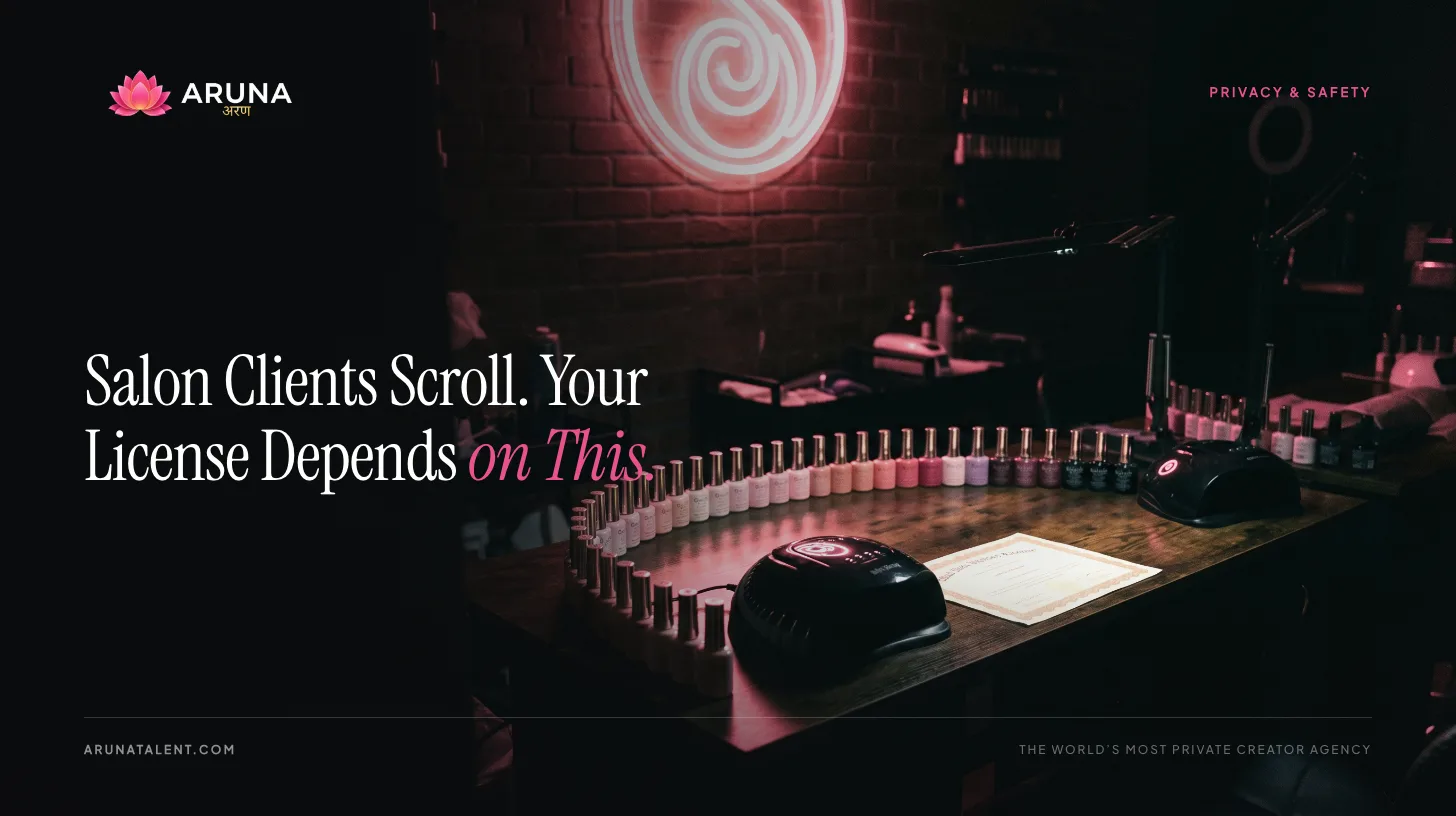
Nail technicians hold state cosmetology or nail technician licenses, making licensing a real secondary risk above the primary employment concern. The client recognition dynamic is particularly significant because nail appointments involve 45 to 90 minutes of one-on-one close physical contact, often recurring every two to three weeks with the same clients across years.
State Licensing Risk
Most states license nail technicians through the state board of cosmetology or the state board of barbering and cosmetology. Some states maintain separate nail technician license categories; others fold nail technician licensing into the broader cosmetology license. The specific board structure varies by state, but the regulatory infrastructure is consistent: a state licensing board with authority to receive complaints, conduct investigations, and impose discipline up to license revocation.
Unprofessional conduct provisions. State cosmetology boards have unprofessional conduct standards that create the complaint pathway. Enforcement history is concentrated on sanitation violations, unlicensed practice, and work-related misconduct, not off-duty adult content creation. A license action against a nail technician solely for adult content would be atypical in current practice. However, the complaint mechanism is real and a complaint initiates a formal process regardless of likely outcome.
Multi-profession board structure. Many states combine nail technician, cosmetologist, esthetician, and barber licensing under a single board. This means the same complaint infrastructure that covers hair and skin professionals also covers nail technicians. Some states include moral fitness or character standards in their broader licensing statutes, which creates a wider unprofessional conduct definition.
State-specific requirements. The degree of licensing exposure depends on your state’s specific cosmetology licensing statute and the board’s published standards of conduct. Nail technicians in states with broader fitness standards face more theoretical exposure than those in states where board enforcement has historically been narrowly practice-focused.
Salon Employment Risk
Nail technicians work across a range of employment and business arrangements, each with a different risk profile.
Independent salon owners. The majority of nail technicians work in independently owned salons where the owner makes all staffing decisions without HR infrastructure. Discovery of an OnlyFans account triggers a personal determination by the salon owner based on their individual values and their assessment of reputational impact on the salon. There is no formal policy process, no HR review, and no appeal mechanism. Outcomes are variable and unpredictable.
Booth rental arrangements. Many nail technicians operate under booth rental or chair rental agreements. They rent space from the salon owner and operate independently. This is not an employment relationship. However, the salon owner can terminate the booth rental agreement at will or when the rental contract allows. A nail technician operating under booth rental is not an employee but is still dependent on the owner’s ongoing willingness to maintain the rental relationship.
Corporate chains and franchise operators. Larger nail salon chains and franchise systems have HR departments and written conduct policies. Discovery at a corporate or franchise-affiliated location follows a more formalized process than at an independent salon. General conduct provisions in employment agreements are typically sufficient basis for termination even without a specific written policy addressing adult content.
Specialty nail salons. High-end nail studios and luxury manicure services may have explicit brand standards tied to staff professionalism. The brand positioning of the employer can raise the sensitivity of discovery.
The Client Recognition Dimension
Nail appointments create a recognition dynamic that distinguishes the profession from most other client-facing work. The physical structure of a nail appointment (client seated directly across from or beside the nail technician, at close range, for 45 to 90 minutes) means the client observes the nail technician’s face, hands, voice, and mannerisms in detail and at proximity for an extended period with each visit.
Repeat nail clients often return every two to three weeks for ongoing nail maintenance. Over the course of a year, a regular client accumulates 20 or more extended close-contact sessions with the same nail technician. The recognition depth that develops is comparable to the familiarity of a recurring personal service relationship.
Social propagation risk. Nail salon clients frequently share recommendations within personal networks. They refer friends, family members, and workplace colleagues to their nail technician. This means the social network surrounding a regular client is likely to contain additional people who are also clients at the same salon. A discovery by one client propagates not just to their personal network but to a network that may already include other clients of the same technician.
Geographic blocking of the salon’s service area addresses the most accessible passive discovery pathway for local clients and the community networks they belong to.
Content Environment Risks
Nail-specific products. Nail polish displays, UV and LED curing lamps, nail files, buffers, cuticle tools, acrylic and gel product containers, nail art brushes, and nail drill equipment are strongly identifiable as nail industry items. Any of these visible in content establishes a connection to nail work.
Manicure station setup. The distinctive layout of a nail workstation (padded client arm rests, lamp positioning, organized supply trays, the specific table height and configuration) is recognizable to any regular nail salon client. A nail station background narrows identification to a nail professional even without specific products visible.
Salon aesthetics and branded attire. Salon-specific lighting setups, décor, and color schemes recognizable to regular clients create identification risk. Branded salon aprons, branded salon attire, or any clothing displaying salon names or logos are direct identifiers.
All content should be created in personal spaces cleared of nail industry products, manicure station setups, and any salon-related visual identifiers.
Identity Protection Framework
Pseudonym. No connection to your real name, salon, or any nail or beauty industry content. No references to nail work, cosmetology, or salon employment in any creator-facing communication.
Content environment. All content created in personal spaces with no nail products, no manicure station setups, no salon lighting or décor, and no professional attire visible.
Geographic blocking. Block the salon’s location and the surrounding client community area. Nail salon clients are local. Geographic blocking closes the passive local discovery pathway.
Device separation. Salon POS systems, booking platforms, and salon email should never touch any creator-related device or account.
How Aruna Talent Supports Beauty and Nail Professionals
Aruna Talent manages creators from nail and beauty professional backgrounds where salon employer discovery and client recognition create real professional risk. Fake name systems across all communications, geographic blocking from the salon area and client community, NDA-enforced team confidentiality, and DMCA monitoring across 500+ sites. Zero identity leaks in four-plus years.
Related guides:
- Hairstylist on OnlyFans, cosmetology licensing risk, salon employer policies, and hairstylist identity protection
- Esthetician on OnlyFans, esthetics license board risk, spa and medical spa employer conduct, and esthetician identity protection
- Personal Trainer on OnlyFans, fitness certification risk, gym employer policies, and personal trainer identity protection
If you’re ready to explore full-service management with privacy infrastructure built for your professional situation, apply to work with Aruna Talent.
Ready to take your content career seriously?
Apply in a few minutes. No upfront cost. No obligation. Not ready? The free Creator Kit gets you started on your own terms.
60+ creators · $10M+ annually total revenue
You Already Know What's Possible. Now Find Out If It's Possible for You.
$20K+ your first week, that's our target, backed by 60+ launches. No followers needed. Your real name, family and location stay private, and a dedicated team drawn from a company of 100+ runs your growth. The only question is whether you apply.
See If You Qualify →No upfront cost · No obligation
How Aruna Can Help